Why Corridor Choice Matters More in Los Angeles Than in Dense Cities
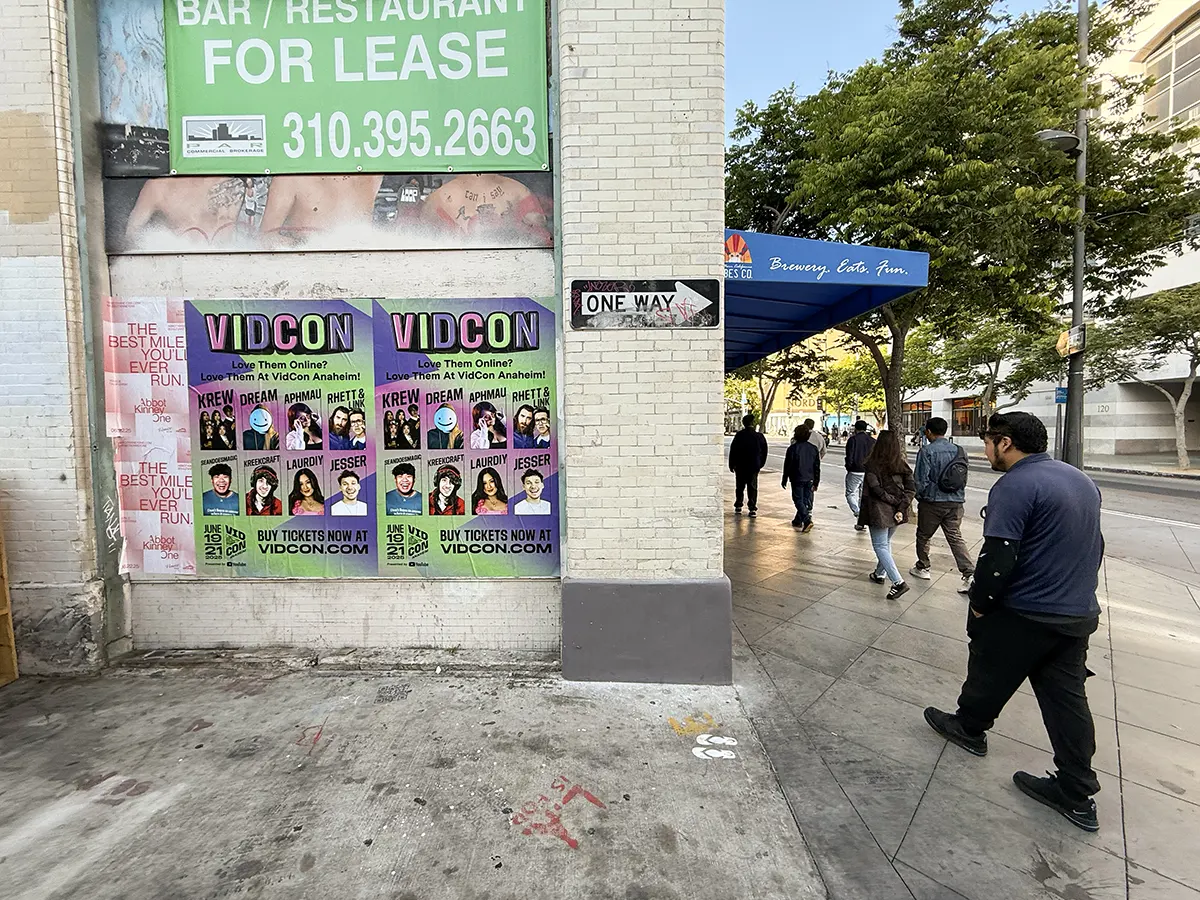
Los Angeles does not behave like a pedestrian city. Attention does not compress naturally into a few dominant sidewalks the way it does in New York. Instead, movement is distributed across neighborhoods, modes of travel, and speeds. That structural difference changes how wheatpasting must be planned if it is expected to work.
Mobility data consistently shows that no single neighborhood in Los Angeles captures a large share of total foot traffic. The top pedestrian areas account for only a small share of overall movement, which means broad placement strategies dilute exposure rather than reinforcing it. In practical terms, a poster placed without corridor logic is likely to be seen once and forgotten.
This is why wheatpasting in Los Angeles succeeds only when corridor behavior is understood and respected. Placement has to account for who is moving through an area, how fast they are moving, and whether they are likely to pass through again.
Los Angeles Forces Posters to Compete With Speed, Not Just Clutter
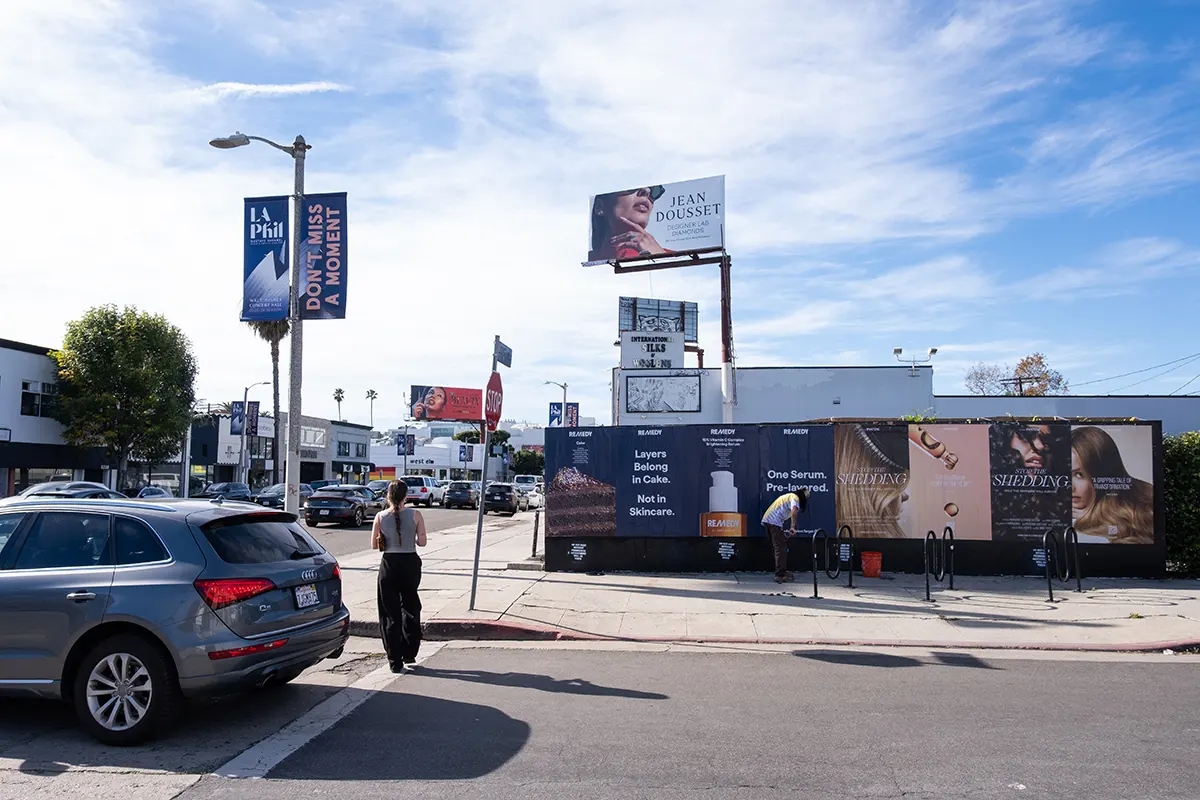
Unlike dense cities where people are already moving slowly, Los Angeles forces posters to earn attention under very different conditions. Many high-visibility areas are vehicle-dominant rather than pedestrian-dominant. That changes how messages are read.
Transportation reporting consistently ranks Los Angeles among the most congested cities in the country, with drivers spending dozens of hours per year in slow or stopped traffic. This congestion creates exposure windows that look different from sidewalk dwell time but can be just as valuable. A driver who stops at the same light every morning sees the same wall again and again, even if they never leave the car.
This dynamic is why wheatpasting in Los Angeles cannot rely solely on pedestrian logic. Poster size, contrast, headline length, and placement height must account for distance and speed. Corridors where vehicles slow predictably can outperform areas with higher foot counts but no repeat visibility.
Corridor Behavior Determines What Type of Wheatpasting Works
Not all Los Angeles corridors reward the same approach. Treating them as interchangeable leads to poor performance, even when placement volume is high. The difference is not the street name. It is the behavior that the street produces.
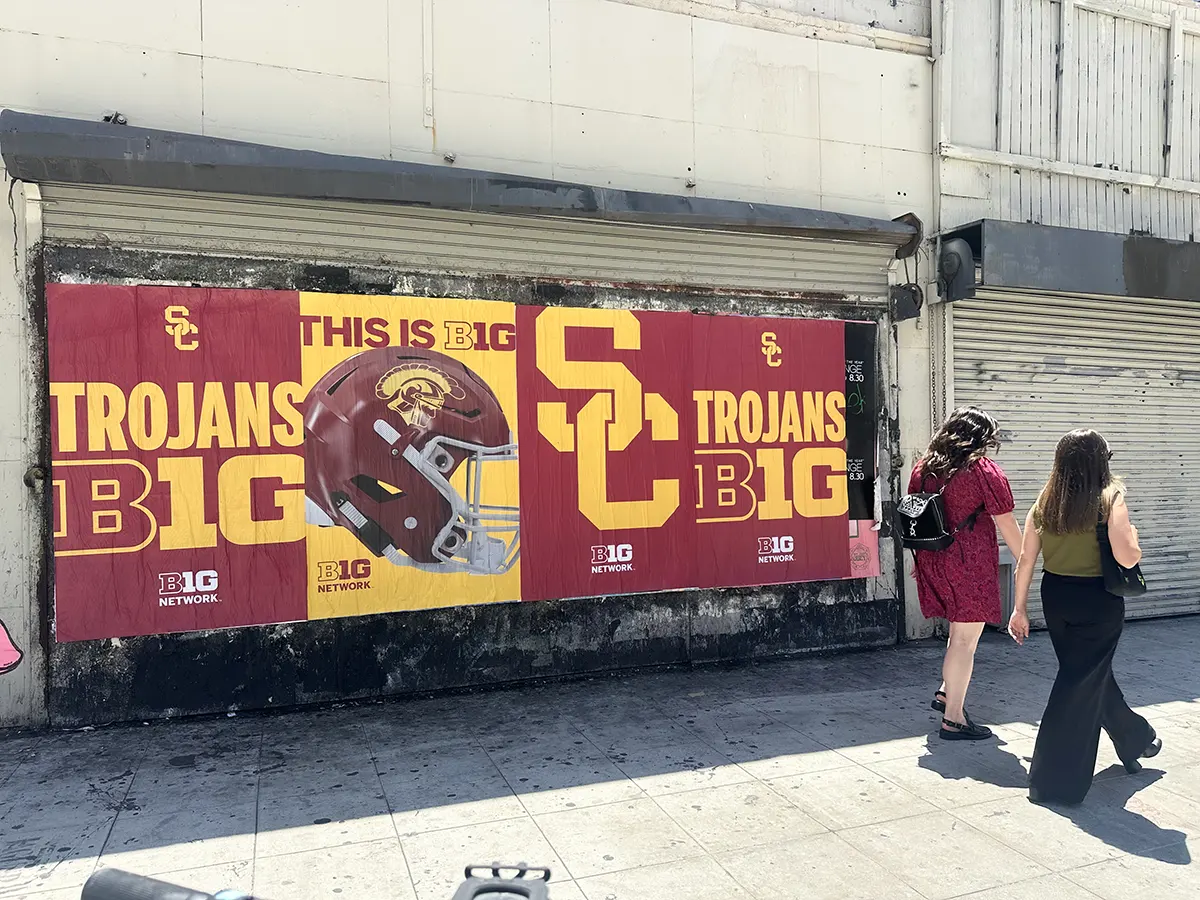
How Major Los Angeles Corridors Behave Differently
Corridor |
Primary Movement |
Typical Viewing Speed |
What Tends to Work |
Why It Matters |
Melrose Avenue |
Pedestrian + slow vehicle |
Slow to moderate |
Bold visuals, culturally relevant creative, repeat density |
Fashion, music, and street culture audiences notice repetition quickly and share what feels native |
Venice Beach / Abbot Kinney |
Pedestrian-dominant |
Slow |
Large visuals, lifestyle-driven imagery, strong contrast |
Long dwell time and photo behavior increase recognition and organic sharing |
Sunset Strip |
Vehicle-dominant |
Slow to stopped |
Large-scale posters, minimal copy, high legibility |
Traffic congestion creates repeated exposure for drivers at fixed points |
Downtown LA |
Mixed, block-by-block |
Variable |
Context-specific placement, architectural awareness |
Visibility changes sharply by block, requiring careful selection |
Echo Park / Silver Lake |
Local pedestrian + nightlife |
Slow |
Smaller formats, consistent repetition, culturally aligned design |
Creative communities respond to familiarity and authenticity over time |
This comparison shows why corridor strategy matters. A poster that works on Melrose can fail on the Sunset Strip, not because the creative is wrong, but because the viewing conditions are different. Wheatpasting in Los Angeles succeeds when placement decisions are driven by behavior rather than assumptions about traffic volume.
Los Angeles Corridors That Actually Matter
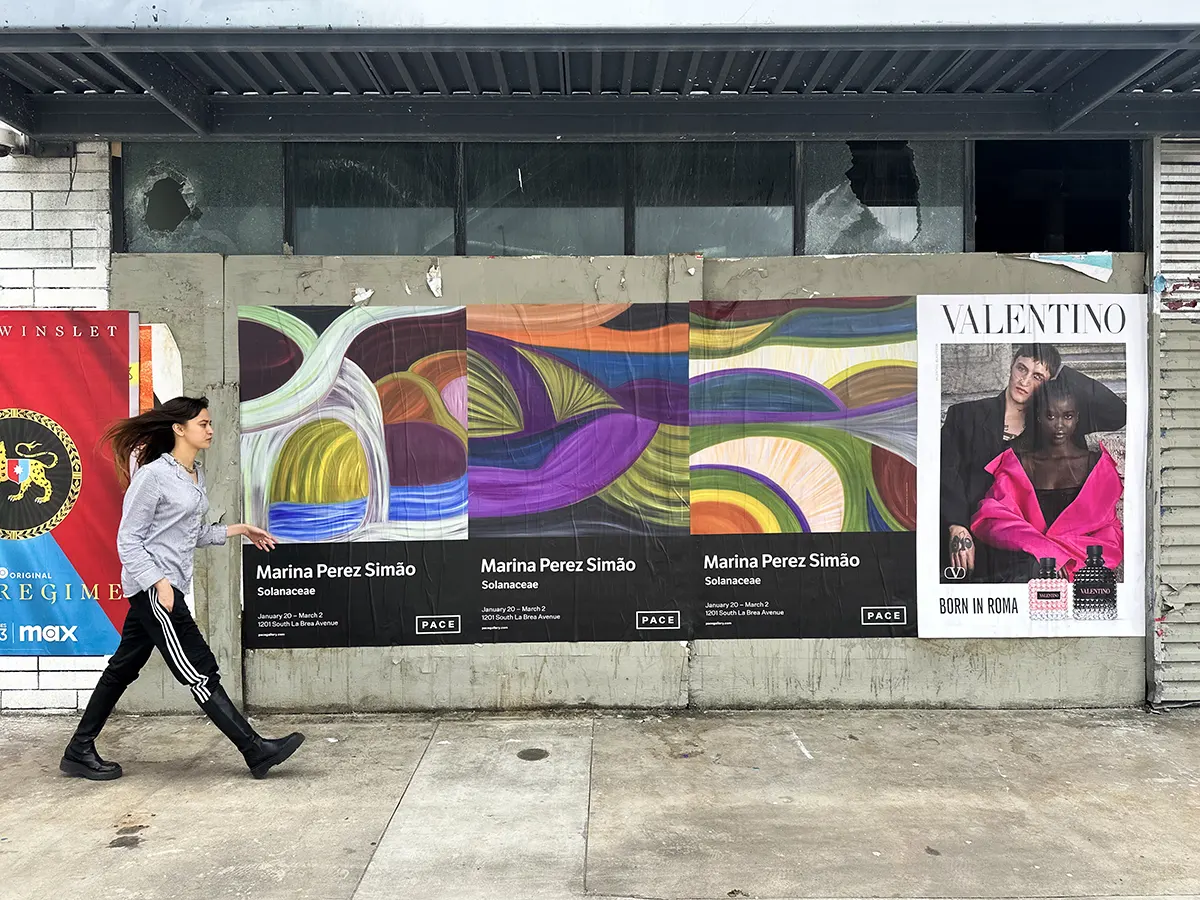
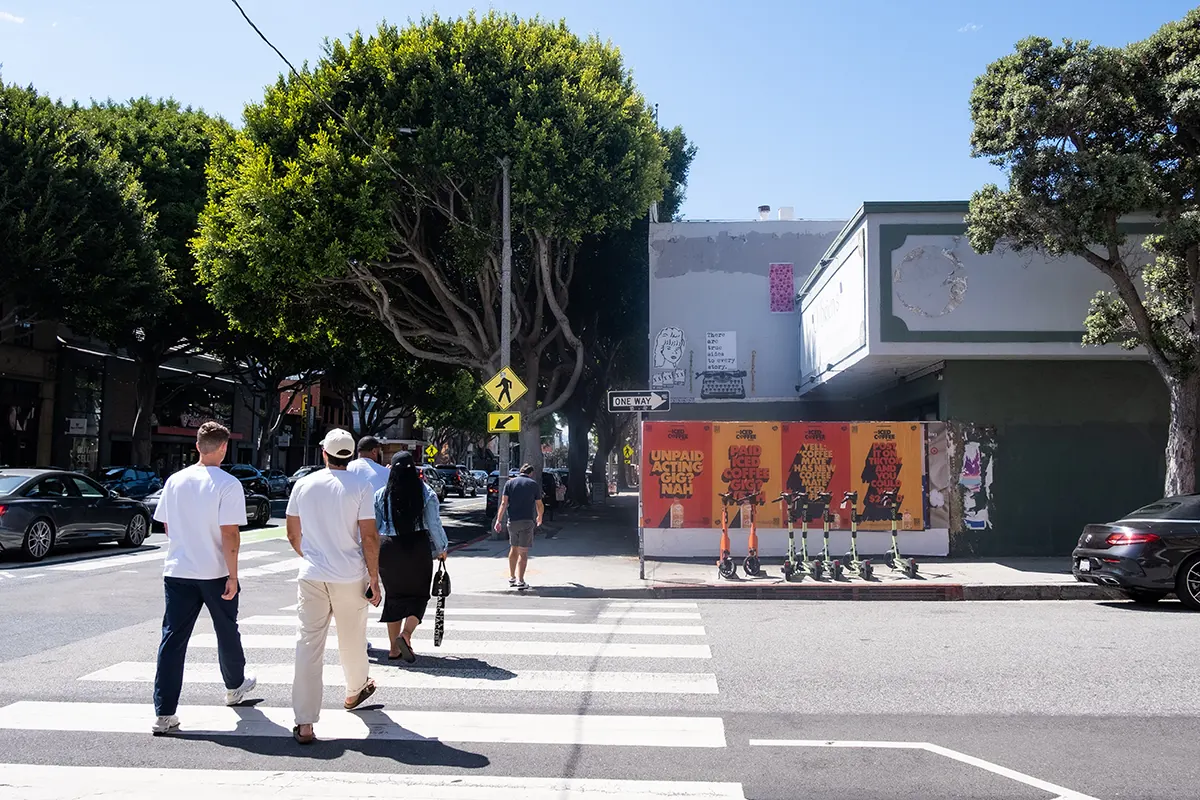
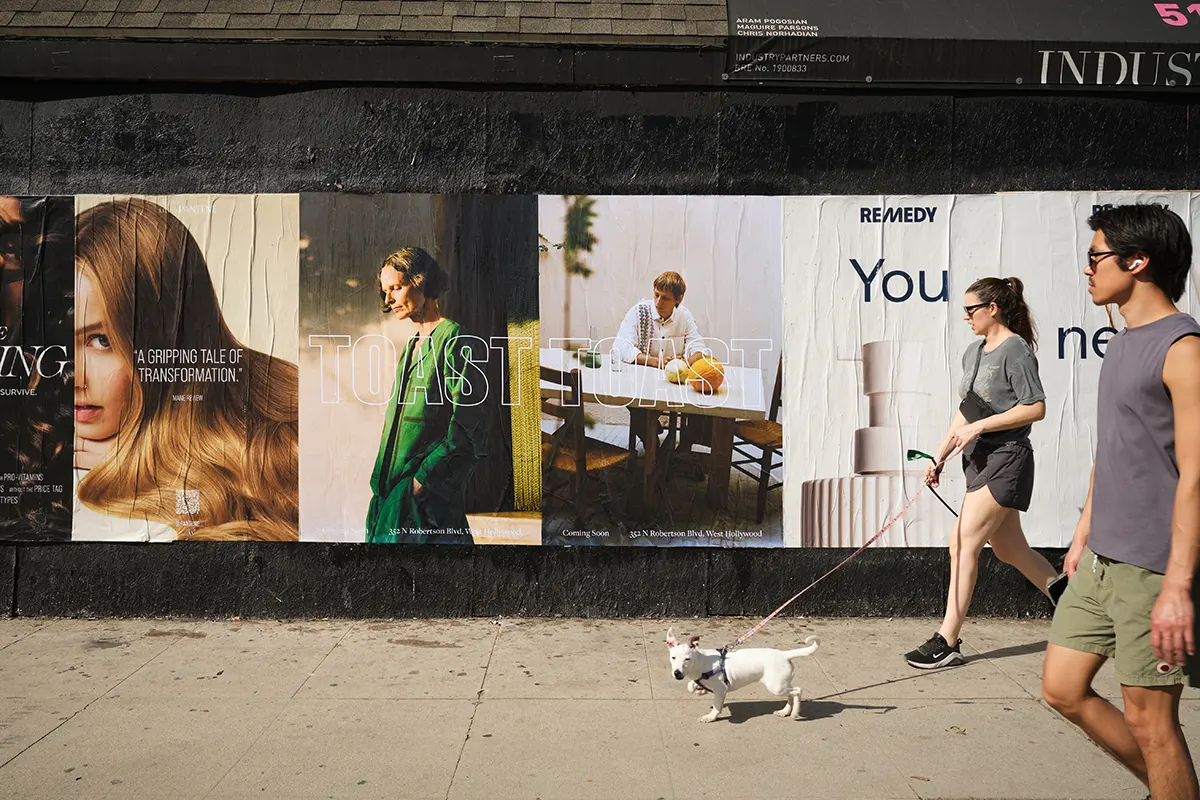
Los Angeles does not reward broad placement. The city’s movement patterns are too dispersed, too variable, and too speed-dependent for repetition to occur by chance. If wheatpasting is expected to build recognition here, corridor choice has to be deliberate and informed by how people actually move through specific areas.
Sunset Strip and the Sunset Corridor
The Sunset corridor behaves as a vehicle-first exposure environment, where visibility is driven by congestion rather than foot density. This changes how messages are seen and how long they stay in view. According to INRIX, Los Angeles drivers lost 87 hours to congestion in 2025, placing the city among the most congested in the United States. That congestion is not evenly distributed. It concentrates along major arterials like Sunset Boulevard, where drivers encounter the same slowdowns at the same points during daily commutes.
LA Metro’s station profile for Vermont / Sunset reports 10,478 average weekday boardings, which adds a secondary layer of pedestrian movement feeding into the same corridor.
- Posters must be readable at distance and at a glance, because the audience is often inside a vehicle.
- Minimal copy and strong contrast outperform clever layouts that require close inspection.
- Density should be near predictable slow zones, not scattered across the corridor as if all blocks performed the same.
Sunset works when wheatpasting respects how congestion creates repetition, not when it assumes pedestrian behavior that does not exist there.
Downtown Los Angeles
Downtown LA does not behave as a single corridor. It behaves as a collection of micro-corridors that change based on destination pressure, time of day, and event schedules. In its October 31, 2025 ridership update, LA Metro reported that during LA Comic Con (September 26–28, 2025), boardings at Pico Station increased by 65 percent compared to non-event days. That spike illustrates how attention in Downtown compresses around events rather than distributing evenly.
At the same time, LA Metro’s station profile for Pico Station reports 10,109 average weekday boardings, showing that this is also a stable weekday movement node. What this means in practice:
- Timing matters as much as location. Install windows should align with known event or destination spikes.
- Blanket Downtown coverage wastes effort because block performance varies sharply.
- Placement should cluster around routes connecting stations, venues, and destination entrances, not random walls.
Downtown rewards planning that treats time as a variable, not an afterthought.
Westside Leisure Anchors (Santa Monica as a Measurable Proxy)
Leisure-driven corridors behave differently from commuter corridors because dwell time is longer and movement is less linear. That difference affects how wheatpasting is processed and remembered. LA Metro’s station profile for Downtown Santa Monica reports 9,403 average weekday boardings. While this does not measure Venice Beach directly, it provides a clean, verifiable movement anchor for the Westside, where pedestrian behavior is driven by browsing, lingering, and social activity.
- Posters can support a slightly richer visual moment, but still need to communicate quickly.
- Placement should favor paths between anchors, not isolated surfaces that rely on chance foot traffic.
- Creative that feels native to the environment is more likely to be photographed and shared.
Leisure corridors reward wheatpasting that understands pace, not just presence.
Eastside Adjacency: Echo Park and Silver Lake
Eastside-adjacent corridors succeed through repeat local exposure rather than tourism volume. Familiarity builds faster because the same audience passes through the same blocks across commuting, errands, and nightlife cycles. LA Metro’s station profile for Westlake / MacArthur Park reports 37,921 average weekday boardings, making it one of the highest-volume transit nodes feeding into eastside-adjacent movement patterns.
- Consistency matters more than novelty. Repeat local routes reward recognizable creative systems.
- Dense placement performs better when it sits inside daily loops rather than one-off paths.
- Maintenance has higher payoff because the same audience will notice degradation quickly.
These areas reward wheatpasting that treats recognition as a cumulative effect rather than a single hit.
OWN THE LA STREETS
Wheatpasting Los Angeles is not a volume game. It is a corridor decision, because movement is dispersed and viewing conditions change block by block. The data shows where repetition is possible and where it is not, and that is what determines whether recognition builds.
Posterize Media’s Los Angeles team can map the right corridors, align creative to real viewing speed, and execute with consistency. To own the streets in LA, start with Posterize Media.