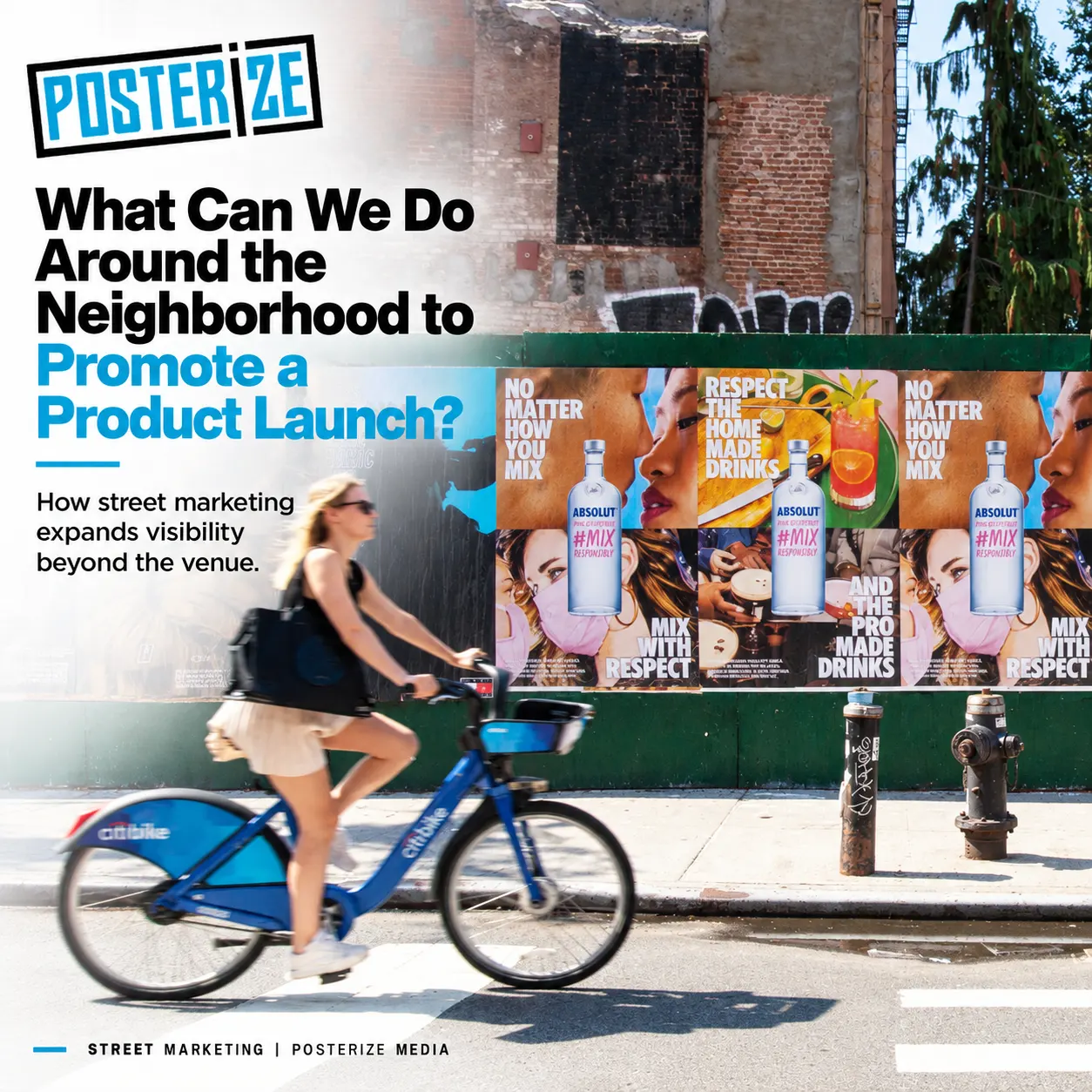
What Can We Do Around the Neighborhood to Promote a Product Launch?
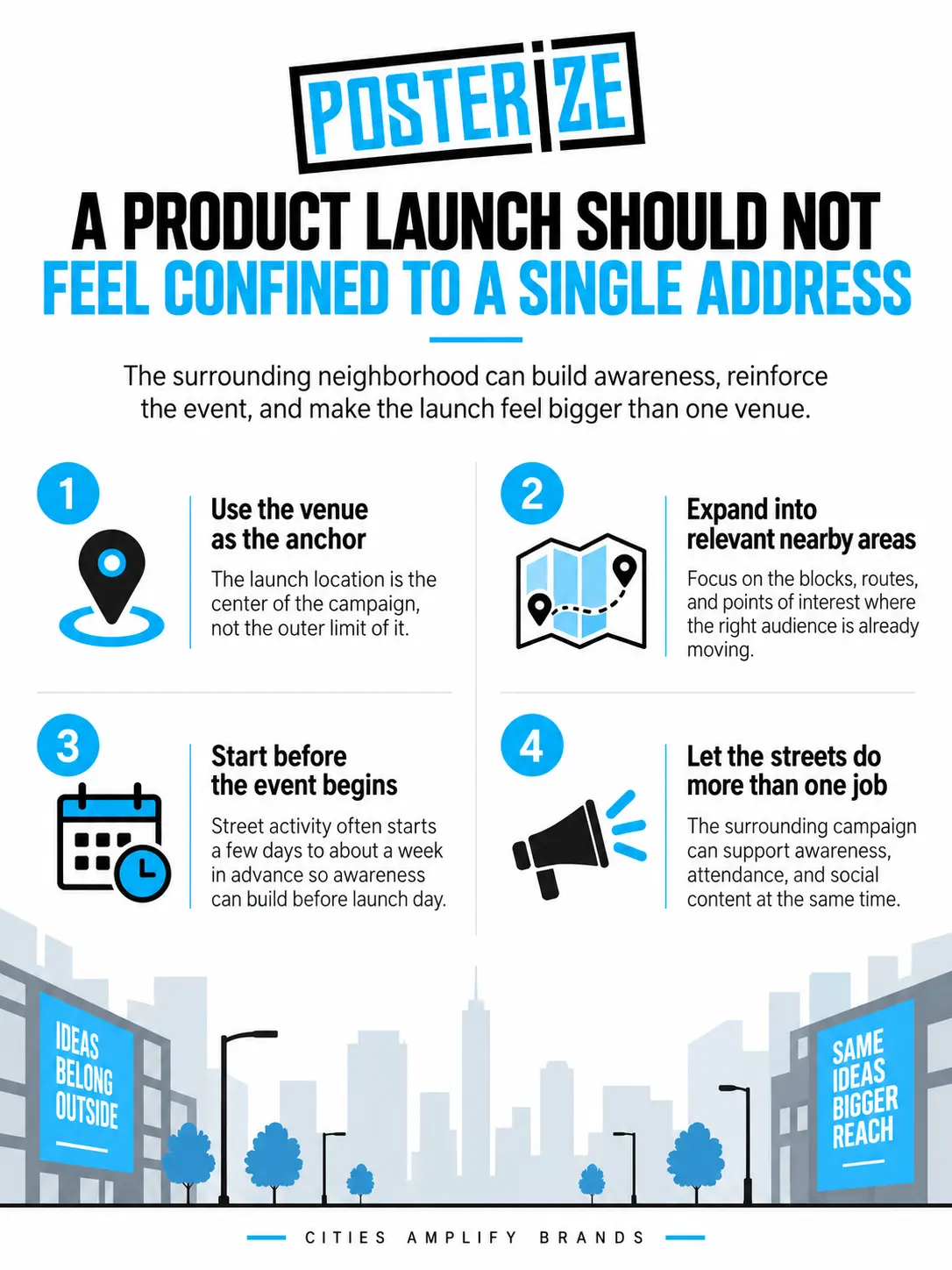
A product launch can be carefully planned inside a venue and still be almost invisible one block away. The event may have the right space, the right creative, and the right audience coming through the door, but none of that automatically gives the launch presence in the surrounding neighborhood. That is where street marketing can change the scale of the moment by extending the launch into the streets people are already using. Our point of view is simple: a product launch should not feel confined to a single address. It should take over the surrounding neighborhood.
For us, that does not mean covering every available surface or drawing an arbitrary radius and filling it. It means treating the venue as the campaign's anchor rather than its edge. Posters, wheatpasting, stickers, projections, and other street-level formats can each support that presence, but only when they fit the location, timing, and job of the campaign. We want the streets around the event to make the launch more visible without pretending there is one formula that fits every venue or brand.
If the Venue Is the Anchor, Where Should Street Marketing Extend?
No universal number of blocks turns an event into a neighborhood campaign. In New York City, our event-related campaigns are typically bought in and around the neighborhood where the event is taking place, but "around" can mean different things depending on the location and scale of the launch. A bar in the Seaport creates a different surrounding environment than a fashion pop-up in a dense shopping district or a brand activation tied to a major sporting event. We use the venue to establish the center of the campaign, then look at the surrounding places where the same audience is already moving before and after the event. Proximity matters, but proximity by itself does not tell us where the useful footprint ends.
That is why we think about the neighborhood in terms of function rather than a perfect circle on a map. The closest placement isn't automatically the most useful, and the busiest street isn't automatically the most relevant. Street marketing around a launch works when the physical environment helps the campaign reach people in a context that makes sense for the event. Three geographic roles are especially useful for understanding that difference.
- The immediate area can connect the campaign directly to the event. People are already approaching, passing, waiting, or spending time close to the venue, so the relationship between the message and the launch is easier to understand.
- The surrounding neighborhood can make the launch feel established beyond one doorway. Repeated exposure on nearby streets gives people more than one opportunity to encounter the brand before they ever reach the event itself.
- Specific points of interest can matter more than a uniform radius. A major event may create useful targets around hospitality locations, gathering areas, nightlife, retail corridors, or other places connected to the audience even when those points are not immediately beside the venue.
The objective is not to claim the greatest possible territory. We are trying to make the launch visible in the part of the city that gives the event context and relevance. A tightly concentrated campaign can create a stronger impression than a thin campaign spread much farther simply to cover more ground. Once we know where the campaign should exist, the next question is when the neighborhood should begin doing that work.
When Should the Neighborhood Start Working for the Launch?
The launch should usually arrive in the neighborhood before the guests do. In our experience, campaigns around events often begin a few days before the event and sometimes about a week beforehand, then continue through the end of the event itself. That timing gives the street marketing campaign a job before the doors open instead of asking it to create all of its impact on launch day. Someone can encounter the brand in the neighborhood, see it again closer to the event, and recognize the connection. By the time the event is underway, the street presence has already had time to establish that something is happening nearby.
We do not treat the longest possible lead time as automatically better. The important point is that the physical campaign and the event should not operate on two unrelated calendars. Starting before the event gives the brand a visible presence while anticipation builds, while continuing through the event keeps that visibility active when the launch is happening. Once timing is aligned with the venue, we can be clearer about what the neighborhood campaign is supposed to accomplish.
What Is the Street Campaign Supposed to Accomplish?
Most launch-related work tries to do more than one thing, but priorities aren't identical from campaign to campaign. Sometimes the main job is to help drive people toward the event. In other cases, attendance is already being handled through invitations, ticketing, influencers, or another channel, and the surrounding campaign is there to make the brand more visible. Often, awareness, attendance, brand presence, and social content are working together. We want the objective to be clear because the same street marketing footprint can perform very differently depending on what the brand needs from it.
The most useful way to frame the campaign is by the added job the neighborhood is doing for the launch. That keeps the discussion focused on purpose, rather than turning it into a menu of formats. It also makes it easier to judge whether a placement helps the event or simply adds more media around it. The table below summarizes the roles that consistently matter in the kind of launch work we handle.
What the neighborhood adds | What that looks like around a launch | Why it matters |
Awareness before arrival | People begin encountering the campaign before they reach the venue or event area. | The launch starts existing in the market before someone walks through the door. |
Support for attendance | Street-level visibility reinforces that something is happening nearby and can point attention toward the event. | The surrounding campaign can help turn local awareness into interest in the destination. |
A larger brand presence | Creative appears across more of the relevant neighborhood instead of existing at one address. | The launch can feel bigger than the physical footprint of the venue itself. |
Content beyond the live audience | The installations give the brand physical creative that can be photographed and filmed around the event. | The campaign can continue through social and other digital channels after the street exposure occurs. |
This is why "promoting the event" can be too narrow a description of what the neighborhood campaign is doing. The street can support attendance while also making the launch visible to people who never enter the venue. It can reinforce the brand for invited guests, create awareness among passersby, and give the client physical content to use elsewhere. With the objective established, the examples become more useful because we can see how the same principle changes with the location instead of treating every launch like the same campaign.
What Do These Campaigns Look Like in Practice?
The clearest examples are when the event itself changes what the surrounding geography means. We have worked on launches and event-driven campaigns where the useful area was a tight cluster of blocks, and others where the audience was spread across several relevant points of interest. Those differences matter because they show why a prebuilt radius would miss the point. Location, audience, and event drive the street marketing footprint, not the other way around.
- Cash App around Formula 1: For Formula 1 activity in Miami and Las Vegas, we placed advertising around specific points of interest connected to the broader race environment rather than treating one venue as the only meaningful location.
- Soho House: For venue-driven activity, we have concentrated placements in the close areas surrounding the relevant Soho House locations so the physical campaign reinforces the place where the event is happening.
- Drink Melo in the Seaport: For an event at a specific bar, the surrounding Seaport area becomes part of the promotional opportunity, allowing people to encounter the brand before they reach the exact address.
- Victoria's Secret pop-up: Posters and stencils were used around the pop-up environment, extending the activation's visual identity beyond the temporary space itself.
These examples do not produce one universal blueprint, and that is the useful part. Formula 1 can create several relevant points of interest, while a neighborhood venue or temporary pop-up may call for a much tighter concentration. In each case, the physical event gives us an anchor and the surrounding environment gives us additional opportunities to make the launch visible. That is a much stronger way to think about the work than simply saying we should advertise "near" the event.
Why Does the Street Campaign Matter Beyond the People Who See It There?
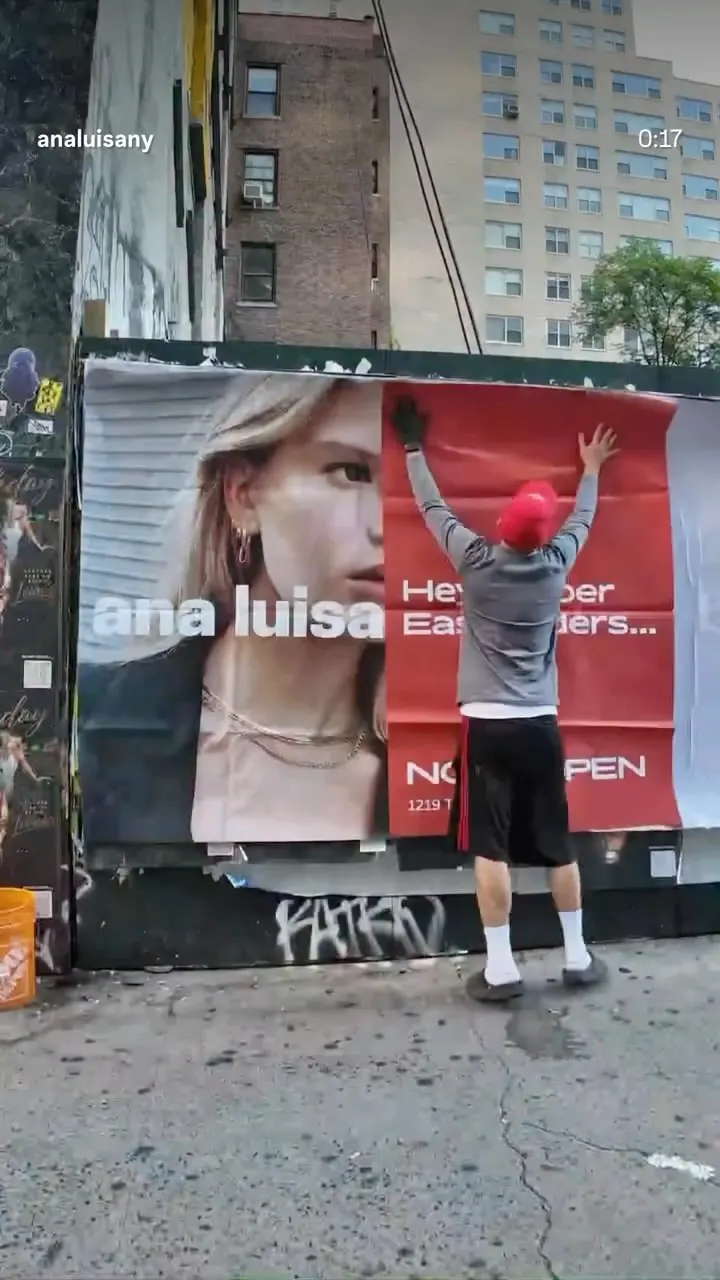
The neighborhood campaign can also give the launch something tangible to carry into the rest of the marketing. We regularly see clients come into the area before or during an event specifically to photograph and film the placements for social media. That changes the value of the installation because the physical work is no longer limited to the people who happen to walk past it in person. A poster wall, stencil, sticker, or other visible execution can become evidence that the launch has entered the real world. The street gives the brand a recognizable place and moment that can be shown to a much larger digital audience.
We still view that content value as a supporting benefit rather than the entire reason for the campaign. The street execution has to make sense for the people encountering it in person, and a photogenic installation cannot compensate for irrelevant placement. When the physical campaign works in the neighborhood and also produces strong visual material, the two audiences reinforce each other instead of competing. That brings us back to the same point: the surrounding area should help the launch extend beyond the room where the event is held.
The Neighborhood Is Part of the Product Launch
One venue may host the product launch, but it does not have to contain the entire campaign. Street marketing lets the surrounding area add visibility, repetition, event interest, and social content while the launch is still timely. When placement, timing, and objective line up, the neighborhood can make the event feel present in the market without assuming every brand needs the same footprint or the same formats. That is why we start with the event and the place around it rather than a prebuilt tactic list. The venue is the anchor; the neighborhood is what lets the launch occupy more of the real world.