Is Projection Advertising Worth It for Your Business?
Businesses do not need more ads people ignore. They need attention people notice, remember, and act on. Projection advertising belongs in that conversation because it gives a business a physical, public, high-visibility way to break out of standard advertising. It turns a real location into a brand moment with scale, movement, and visual impact.
Most businesses already understand why projection advertising looks impressive. The better question is whether it deserves a serious marketing budget. That answer needs more than opinion. It needs numbers that show why public, visual, real-world advertising has value.
The strongest proof comes from research around digital out-of-home advertising, brand experiences, and public visual media. These sources do not prove a clean projection-only ROI number, and they should not be stretched to say that. They prove something more useful and more honest. People respond to public visual advertising when it is noticeable, visually engaging, and tied to a real experience.
Projection Advertising Turns a Location Into a Business Asset
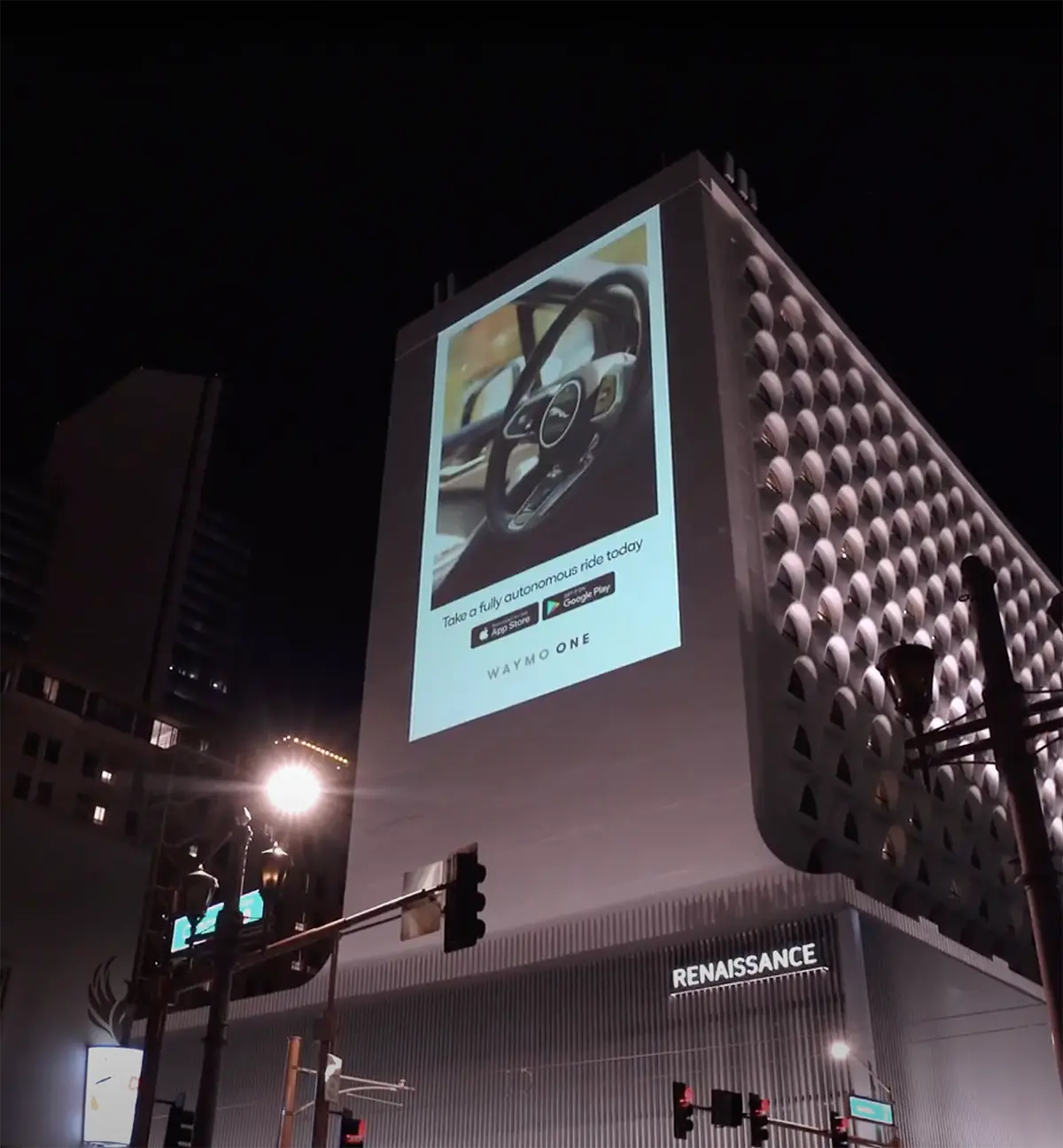
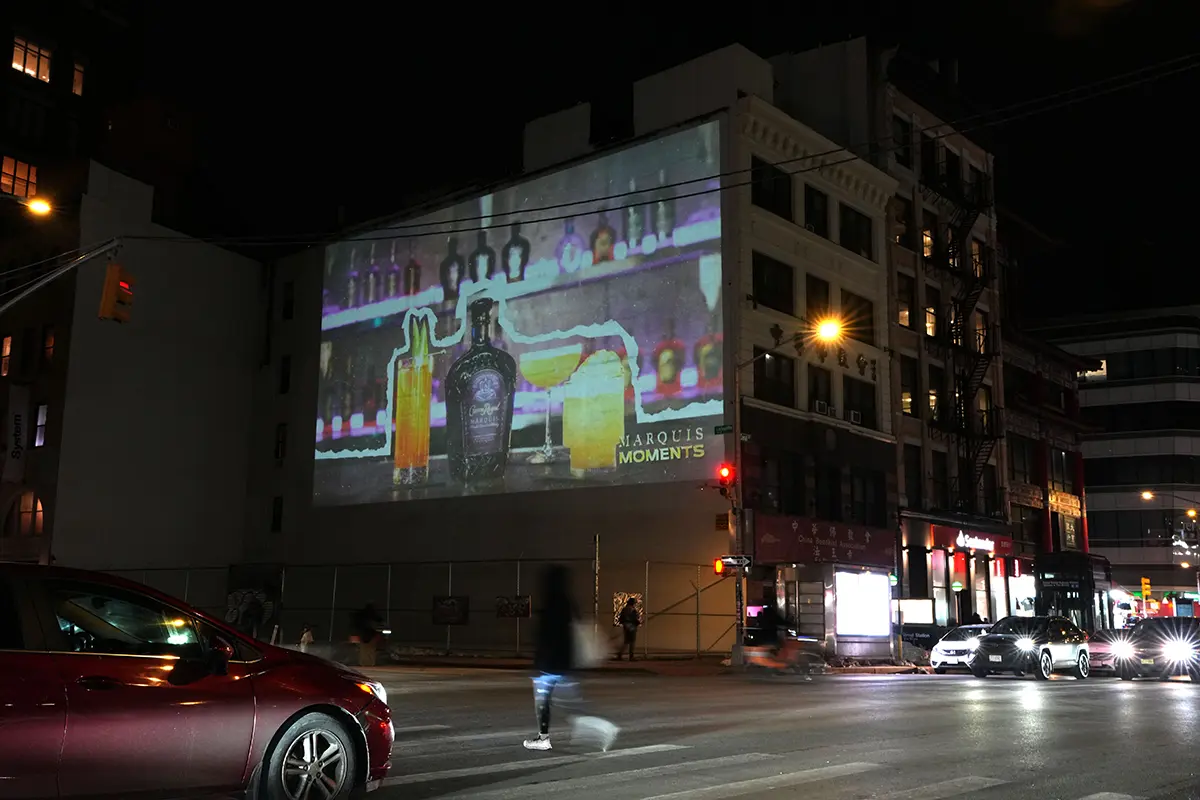
Projection advertising is not only a visual effect. For a business, it is a way to turn a physical location into a media asset. That location might be a building, storefront, wall, venue, event space, restaurant exterior, trade show area, or other public-facing surface. The value comes from using that real place to create attention the audience can see and experience in person.
A standard ad often has to fight for attention inside a crowded channel. Projection advertising changes the setting around the audience. It gives people something visible, public, and unusual enough to stop for. That difference is why the format deserves serious business consideration.
For a business, the value is not just the projection itself. The value is the attention, recall, content, social sharing, and brand presence that a projection campaign can create. A strong projection campaign gives the business a visual moment that can live in person and continue through photos, video, social media, paid ads, press, email, and sales materials. That gives the campaign more use than a one-time placement.
The business case starts with these core advantages:
- It gives the brand public visibility.
- It makes the message harder to ignore.
- It creates a real-world brand moment.
- It supports social sharing and content capture.
- It connects advertising to a physical location.
- It helps brands stand apart from traditional advertising.
- It gives the campaign a stronger visual asset than a standard ad.
- It supports awareness, action, purchase interest, and brand lift goals.
That is the point of projection advertising as a business tool. It is not only light on a wall. It is a way to make the brand bigger, more visible, and more memorable in the real world. For businesses trying to break out of the mold, that kind of presence has value.
The Numbers Prove Public Visual Advertising Works
Projection advertising works because it uses the same forces that make strong public visual media effective: scale, visibility, movement, location, and visual appeal. Research on digital out-of-home advertising is useful because it measures how people respond when ads appear in the real world, not just on a private screen. Projection advertising takes that same public visual environment and makes it larger, more noticeable, and more memorable. That is why the numbers matter.
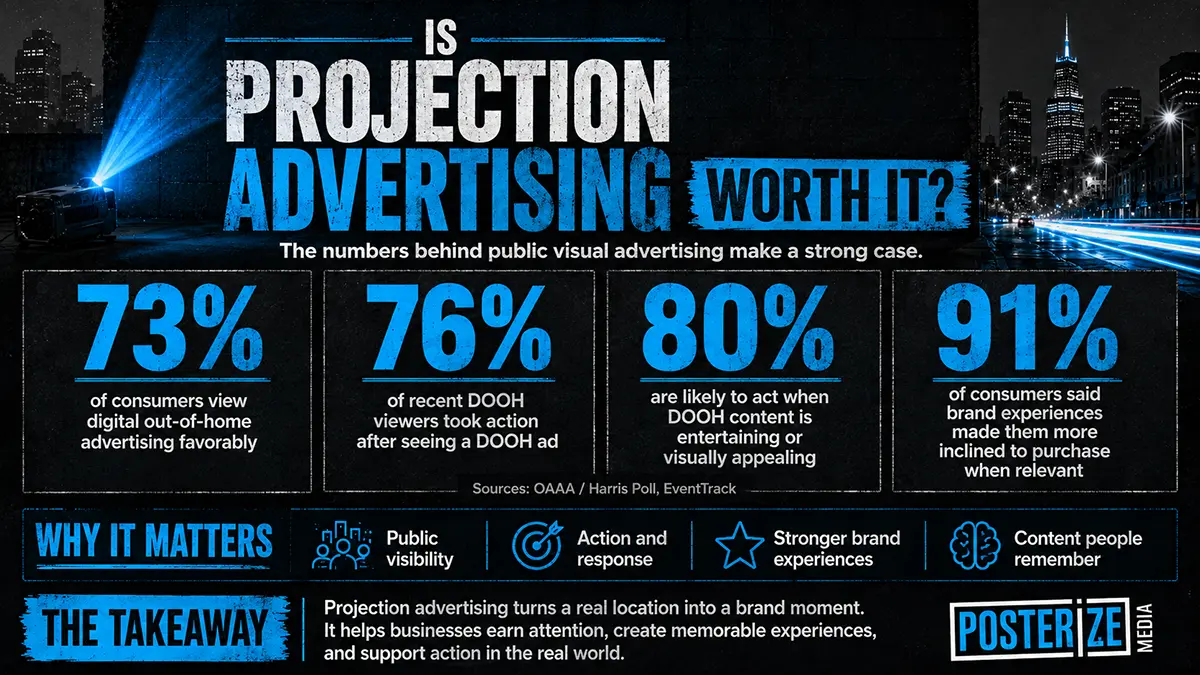
According to a 2024 study commissioned by the Out of Home Advertising Association of America and conducted by The Harris Poll, 73% of consumers view digital out-of-home advertising favorably. The same study found that 76% of recent DOOH viewers took action after seeing a DOOH ad. It also found that 80% of consumers said they were likely to act after seeing DOOH content they considered entertaining or visually appealing.
Those numbers support the case for projection advertising because projection is built around public visual impact. It is not a small ad fighting for attention on a screen. It is a real-world display that can turn a building, storefront, wall, or event space into something people notice. For businesses trying to break out of traditional advertising, that is the value.
Here is the simplest way to understand the numbers.
What the research found |
Why it matters for projection advertising |
73% of consumers view DOOH favorably |
Public visual advertising has strong consumer acceptance |
76% of recent DOOH viewers took action |
Real-world visual ads can prompt behavior |
80% are likely to act when DOOH is entertaining or visually appealing |
Projection advertising is built for visual impact |
These are not projection-only ROI numbers, and they should not be presented that way. They prove something more practical: people respond to public visual advertising when it is noticeable, relevant, and visually engaging. Projection advertising fits that business case because it gives brands a high-impact way to show up in the physical world.
The Data Supports Action, Not Just Awareness
The numbers matter because they go beyond people seeing an ad. They show that people take action after seeing strong public visual media. That is the difference between a campaign that only looks impressive and a campaign that has business value. Projection advertising belongs in that action-driven environment because it is public, visual, and built to be noticed.
The 76% action statistic is especially important. It shows that digital out-of-home does more than sit in the background. Recent viewers reported taking action after seeing it. That action might include searching, visiting, buying, sharing, talking, scanning, or engaging with the brand.
Projection advertising should be judged in that same way. The format gets attention because it is large and public. The business value comes from what that attention supports. A strong projection campaign can help move people toward a brand, location, event, product, page, or conversation.
Brand Experiences Increase Purchase Interest
Projection advertising also aligns with the broader value of brand experiences. This matters because projection is often used when a brand wants more than an ad placement. It is used when the brand wants a launch, event, opening, reveal, or public moment to feel bigger and more memorable. That places projection advertising in the same business conversation as experiential marketing.
According to the 2021 EventTrack study conducted by Mosaic and Event Marketer, 91% of consumers reported that participating in brand events and experiences made them more inclined to purchase a product or service when the offering was relevant to their interests. That is one of the strongest numbers supporting the value of experience-based marketing. It shows that the right kind of brand experience can influence purchase interest. Projection advertising can help create that kind of experience by making the brand visible, physical, and memorable.
This does not mean every projection campaign will automatically drive purchases. It means the format aligns with a proven behavior. People are more open to buying when a brand experience feels relevant and engaging. Projection advertising gives businesses a way to make that experience feel larger and more public.
The purchase-interest case is direct and useful.
What the research found |
Why it matters for projection advertising |
91% of consumers said brand events and experiences made them more inclined to purchase when the product or service interested them |
Projection advertising can turn a campaign into a stronger brand experience |
Brand experiences create stronger emotional and physical contact than routine ads |
Projection advertising gives a business a visible real-world moment |
Experience-based campaigns create content, conversation, and recall |
Projection advertising gives the campaign something people can see, record, and remember |
This is one of the clearest reasons projection advertising deserves serious consideration. It gives the business a way to move beyond ordinary exposure. It helps create a brand experience that feels active, public, and worth paying attention to. That is a stronger position than another static ad in another crowded channel.
For businesses that want to break out of traditional advertising, this matters. You do not need another ordinary ad in another ordinary placement. You need a campaign that gives your brand presence. Projection advertising gives you that option, and Posterize Media helps make it real.
Is Projection Advertising Worth It?
Projection advertising is worth serious consideration because the numbers behind public visual advertising and brand experiences are strong. OAAA and The Harris Poll found that 73% of consumers view DOOH favorably, 76% of recent DOOH viewers took action, and 80% are likely to act when the content is entertaining or visually appealing. EventTrack also reported that 91% of consumers are more inclined to purchase after relevant brand experiences.
That is why projection advertising is not a gimmick. It connects to proven marketing forces: attention, action, purchase interest, and content value. If you want to know how projection advertising could work for your business, contact Posterize Media to start the conversation.