What’s the Difference Between Projection Ads and Traditional Billboards?
A billboard gives a brand a fixed place in the market. A projection ad gives a brand a short window to make a place feel different. That difference sounds simple, but it changes almost every practical decision behind the campaign.
When clients ask us about projection ads, they are not usually looking for the same thing they would get from a traditional billboard. They are usually looking for a large, high-impact location on short notice for a couple of nights. They want a building, wall, or street-facing surface to become part of the message. That makes projection advertising a better fit for launches, pop-ups, event timing, and short-run visibility pushes. Traditional billboards still matter, but they solve a different problem. They work best when the campaign needs steady exposure, repeated market presence, and a media placement that stays visible over a longer flight.
A Billboard Buys Presence. A Projection Ad Creates a Moment
The real difference between projection ads and traditional billboards is not only the format. It is the job each format performs. A billboard is built for continuity. A projection ad is built for impact in a specific time, place, and environment.
In the OOH Glossary of Terms, published by the Out of Home Advertising Association of America in 2022, a billboard is defined as a large-format advertising display intended for viewing from more than 50 feet away. That matters because a billboard has to work at distance. It has to communicate fast. It has to stay readable as people pass by on foot, by car, by bus, or by bike.
Projection ads work with a different set of rules. The surface is not a standardized billboard face. The surface might be a building wall, facade, storefront, warehouse side, event wall, or other public-facing structure. The location itself becomes part of the media. That gives projection its power, but it also adds more field conditions that need to work.
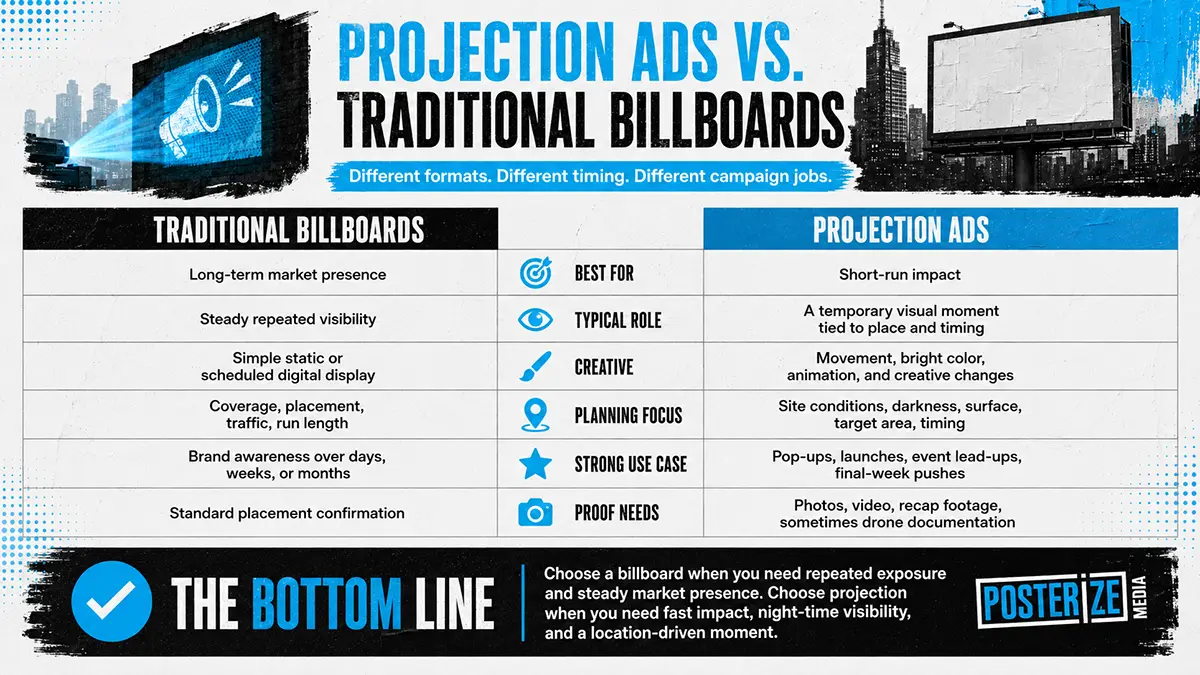
The basic choice comes down to the visibility the campaign needs. This table gives the simplest way to frame the decision before getting into the details.
Campaign Need |
Traditional Billboard |
Projection Ad |
Best for |
Long-term market presence |
Short-run impact |
Typical role |
Repeated visibility in a fixed media location |
A temporary visual moment tied to place and timing |
Creative behavior |
Static or scheduled digital display |
Movement, bright color, animation, and creative changes |
Planning focus |
Market coverage, placement, traffic, run length |
Site conditions, darkness, surface, target area, timing |
Strong use case |
Brand awareness over days, weeks, or months |
Pop-ups, product launches, event lead-ups, final-week pushes |
Proof needs |
Standard placement confirmation |
Photos, video, recap footage, and sometimes drone documentation |
This is not a better-or-worse comparison. It is a fit comparison. If a client needs long-term market presence, a billboard is often more cost-effective. If a client needs a short, sharp moment tied to a launch, event, pop-up, or location, projection ads deserve a serious look.
Timing Changes the Whole Media Decision
Timing is one of the clearest differences between the two formats. A traditional billboard usually supports a longer campaign flight. It gives the brand repeated exposure in the same market over days, weeks, or months. That repetition helps when the message needs to build recognition.
Projection ads are different because they often work best when the timing is compressed. A projection can support a product launch, the last week of an event, a pop-up, a film release, a fashion moment, or a short market push. The short run is not a weakness when the campaign goal is urgency. It is part of the strategy.
That is why we do not judge projection ads only by how long they stay up. A projection might run for a couple of nights and still make sense if it lands in the right place at the right time. The goal is not always repeated exposure. Sometimes the goal is to make a brand feel present during a specific cultural or commercial moment.
This timing difference matters most when the campaign has a clear deadline or public moment. Projection ads tend to make more sense when the campaign needs to respond to a specific window.
- A pop-up needs local visibility before and during the activation, not months of general awareness.
- A new product launch needs impact when the brand is already trying to drive attention across other channels.
- The final week of an event needs urgency, because the message loses value after the date passes.
- An entertainment, fashion, or cultural campaign may need to show up near the audience at the exact moment attention is highest.
Those examples show why projection works best when timing is part of the message. If the campaign needs constant visibility for several weeks, a billboard has the cleaner structure. If the campaign needs to show up fast, look big, and make a location feel activated, projection advertising fits the brief more closely.
Billboards Win When the Message Needs Repetition
Traditional billboards still have a clear advantage when the campaign needs scale, repetition, and standardized media planning. They are built for long-term visibility. They sit inside a mature OOH buying structure with known formats, defined markets, and established measurement language.
Geopath’s OOH measurement materials define impressions as the number of times people are likely to notice an ad on an out-of-home display. Geopath also uses reach and frequency to help advertisers understand how many people the campaign reaches and how often the audience sees the message. That structure gives billboards a major planning advantage when the client needs measurable exposure across a market.
This does not make billboards better than projection ads. It makes them better for a different job. A billboard supports steady awareness. It gives a brand a known location, a known run, and a repeatable presence. That works for campaigns built around brand recognition, market coverage, and simple message retention.
A billboard is usually the better fit when the campaign needs these conditions.
Billboard Campaign Condition |
Why It Matters |
The message needs repeated exposure |
Repetition helps build recognition over time. |
The campaign runs for several weeks or months |
Billboards fit longer media flights better than short-run projection. |
The creative needs to stay simple and consistent |
Large-format billboard creative is usually built for fast reading at distance. |
The brand needs broad market coverage |
Billboards fit standard OOH planning across defined locations. |
The client wants a fixed, known media placement |
The location, format, and run are easier to define upfront. |
A projection ad can still create a strong public moment, but it does not replace every billboard use case. If the brand needs sustained awareness over a longer period, the billboard structure often provides a stronger foundation for the campaign.
Projection Ads Win When the Place Becomes Part of the Creative
Projection advertising becomes strongest when the campaign needs more than a flat placement. It works when the surface, the building, the street, and the timing help tell the story. That is the part a traditional billboard cannot always match.
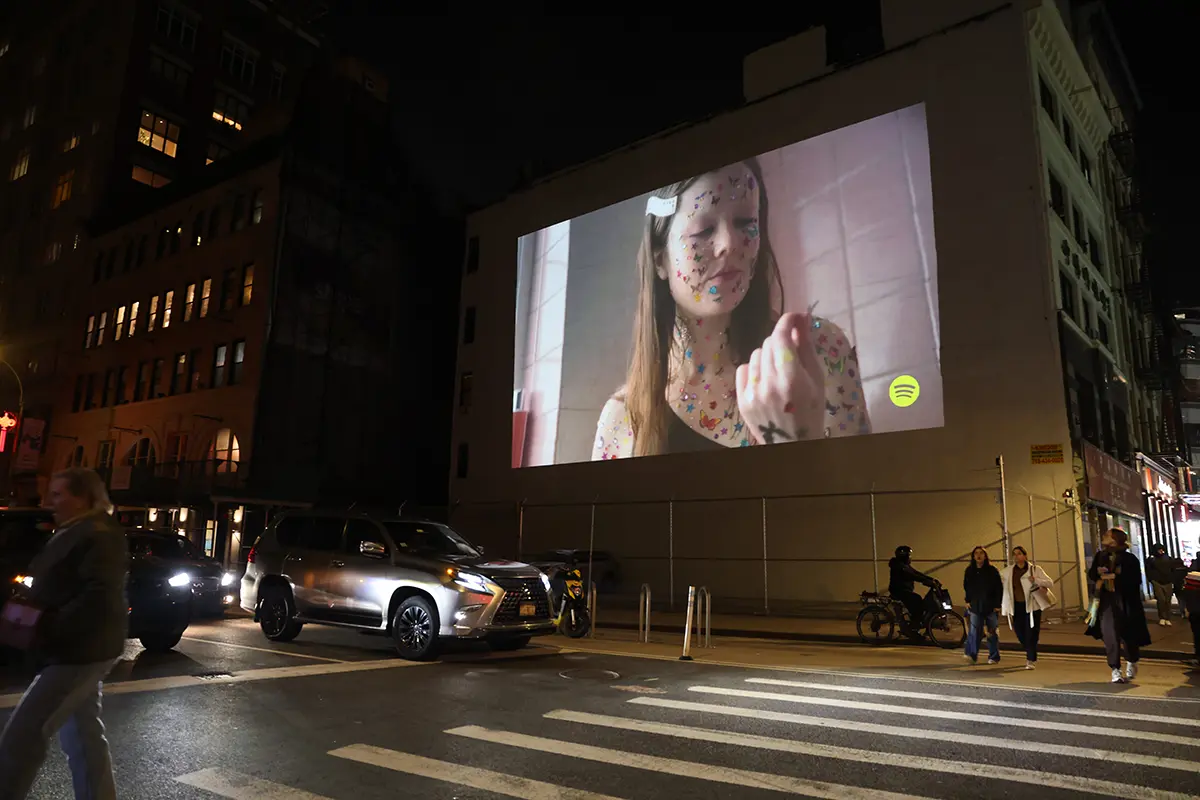
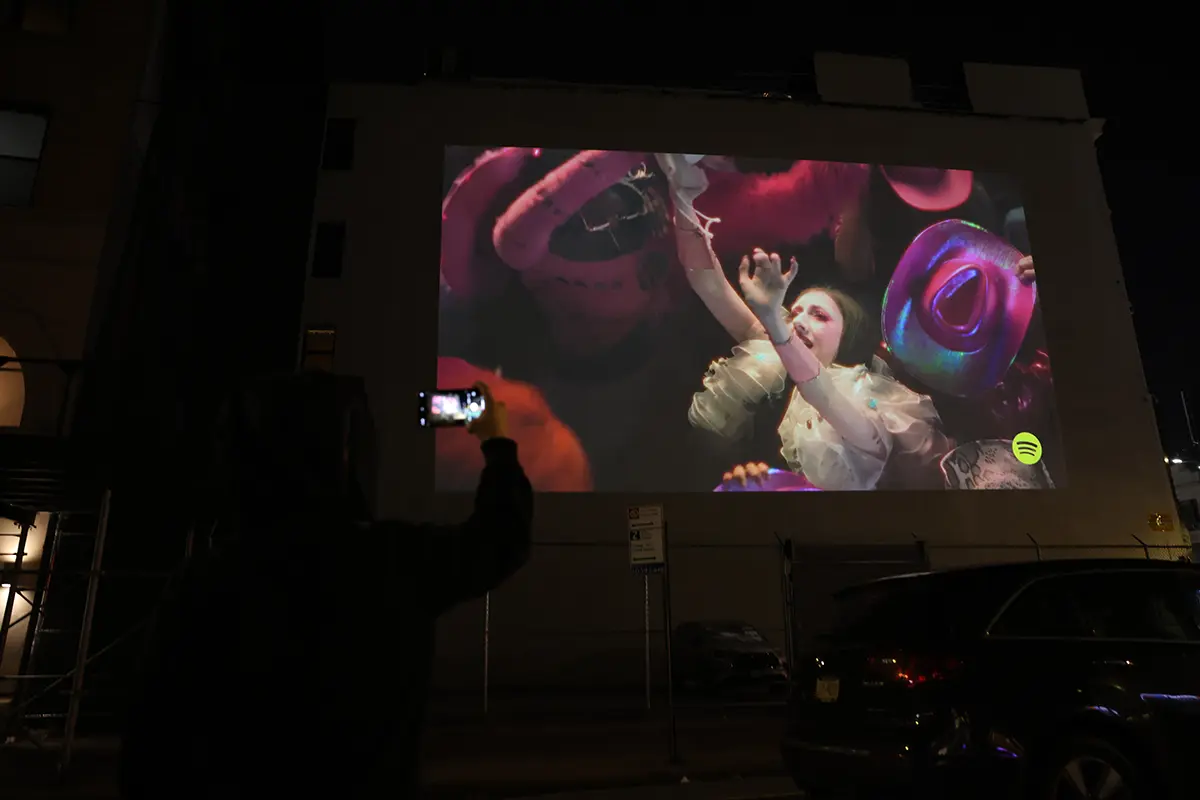
A projection ad can move. It can shift through a couple of creative changes. It can use bright colors, animation, and visual transitions to hold attention. Those changes matter because the audience is not only seeing a message. They are watching a public space change in front of them.
The 2024 Ipsos report “Unlocking the Creative Potential of Out-of-Home Advertising” argues that OOH creativity is most effective when brands use strategic placement, eye-catching visuals, storytelling, and the surrounding environment to create a memorable experience. That point is central to projection advertising. The best projection is not a billboard image placed on a wall. It is a moment of creativity shaped by the wall, the street, and the people passing through that space.
That is why movement matters. A static projection can still look large, but motion gives people a reason to keep watching. A couple of creative changes can also help the campaign feel more alive without overwhelming the message. Bright colors help the projection stand out, especially when the surrounding environment competes for attention.
The best projection campaigns do not depend solely on size. They depend on how the creative behaves in the environment. If the image moves well, reads clearly, and feels connected to the location, the campaign is more likely to feel like a moment rather than a temporary sign.
Visibility Depends on More Than Size
A large placement does not guarantee a strong campaign. Size helps, but visibility depends on how people encounter the message. A billboard has to be readable from a distance. A projection has to be bright, legible, and placed where people have enough time to process it.
That difference affects creative choices. A billboard often needs a simple message, strong contrast, and a fast read. Projection ads have more room for movement and visual change, but they still need discipline. If the projection changes too much, moves too fast, or relies on details that get lost at a distance, the impact drops.
This is why we look closely at audience movement. Foot traffic matters, but raw foot traffic is not the whole story. A corner where people pause at a crosswalk may be stronger than a location where people move quickly past the wall. A venue exit may work better than a busy stretch where nobody turns their head. A darker surface with bad reflectivity may lose to a smaller but cleaner projection wall.
The visibility question changes by format.
- For a billboard, we ask whether people can read the message quickly at distance.
- For a projection ad, we ask whether the environment lets the image hold attention.
- For a billboard, the placement already exists as media.
- For a projection ad, the site has to be turned into a media surface.
- For a billboard, the creative needs to survive speed.
- For a projection ad, the creative needs to survive light, surface, angle, and distance.
Those differences are why the same artwork should not always be used for both formats. A billboard file placed into a projection environment can feel flat or unreadable. A projection concept placed on a billboard can lose the movement and timing that made it work. Each format needs creative built for the way people will see it.
The Right Choice Depends on the Campaign Job
Projection ads and traditional billboards do different jobs. A billboard gives a brand steady presence in a market. A projection ad turns a specific location into a short-run visual event.
Use a billboard when the campaign needs repeated exposure, broad visibility, and simple creative that works from distance. Use a projection ad when the campaign needs short-notice impact, night-time visibility, movement, creative changes, and documentation from a specific place and moment.
We do not start with which format looks bigger. We start with what the campaign needs to accomplish. Sustained presence usually points to a billboard. A concentrated moment tied to a launch, pop-up, event window, or location points to projection advertising.