What Makes a Building Good for Projection Advertising?
Projection advertising looks simple from the outside. A brand finds a wall, sets up a projector, and puts content into the city. That assumption is exactly why so many campaigns underperform. What appears to be a strong location during the day often fails at night, not because of the creative, but because the building and its environment were never evaluated properly.
A building is only effective for projection advertising when it can support light, visibility, and viewing conditions simultaneously. That means the surface must reflect light correctly, the surrounding environment must allow contrast, the projection must be physically achievable, and people must be able to see and process it. If those conditions are not met together, the projection will not perform, regardless of how strong the concept is.
Surface Material and Reflectivity
The first step is understanding how the building handles light, because projection is fundamentally a light problem.
A projection exists only if the surface can return light to the viewer in a consistent way. Matte, light-colored façades perform best because they scatter light evenly across the image. That allows the projection to maintain clarity and uniform brightness. Dark materials absorb a significant portion of that light, immediately weakening the image. Reflective or glossy surfaces create a different issue. Instead of absorbing light, they redirect it unevenly, producing glare, hotspots, and areas where the image becomes unreadable.
Glass surfaces are often the most misleading. They appear open and clean, but they do not function as reliable projection surfaces. They reflect surrounding light sources, including streetlights and traffic, which compete directly with the projected image. This is where the core idea begins to take shape. A building is not selected because it has space, but because it can carry light without distorting it. If the surface cannot do that, the projection loses clarity before any other factor comes into play.
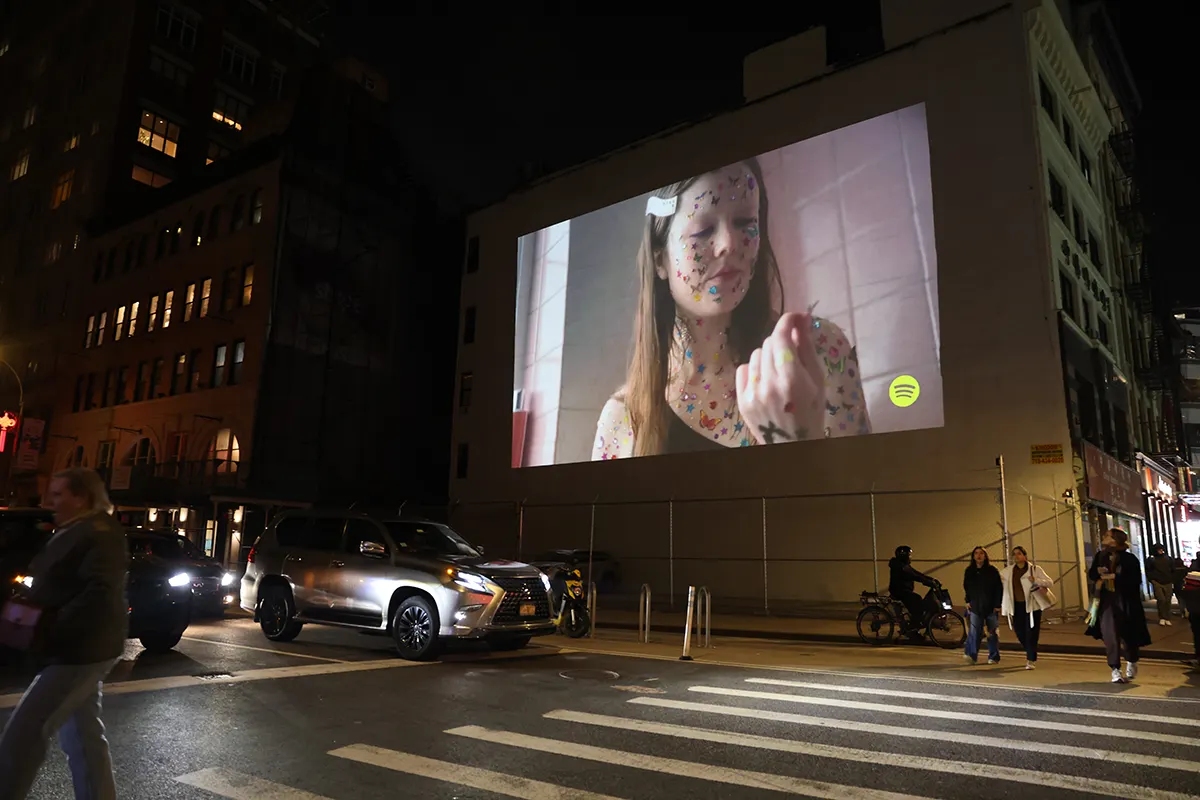
Surface Shape and Architectural Complexity
Once the surface material supports light, the next question is whether the building can hold the image in its intended form.
Flat façades are the most dependable because they preserve alignment and proportion. The image behaves as intended. As soon as the building introduces depth through windows, recesses, or structural variation, the projection becomes more complex. At that point, the image has to adapt to the building. Without proper alignment, it stretches across edges, breaks at transitions, and loses its structure. What appears strong in concept becomes fragmented in execution.
Complex buildings can still work, but they require planning and calibration. The façade must be treated as a three-dimensional surface, and the projection must be adjusted accordingly. Even then, some projections appear correct only from certain viewing positions, limiting how the audience experiences the image. This connects directly back to the thesis. A building is only effective if it can hold the image in real conditions. Visual interest alone does not make a structure suitable for projection.
Ambient Light and Contrast
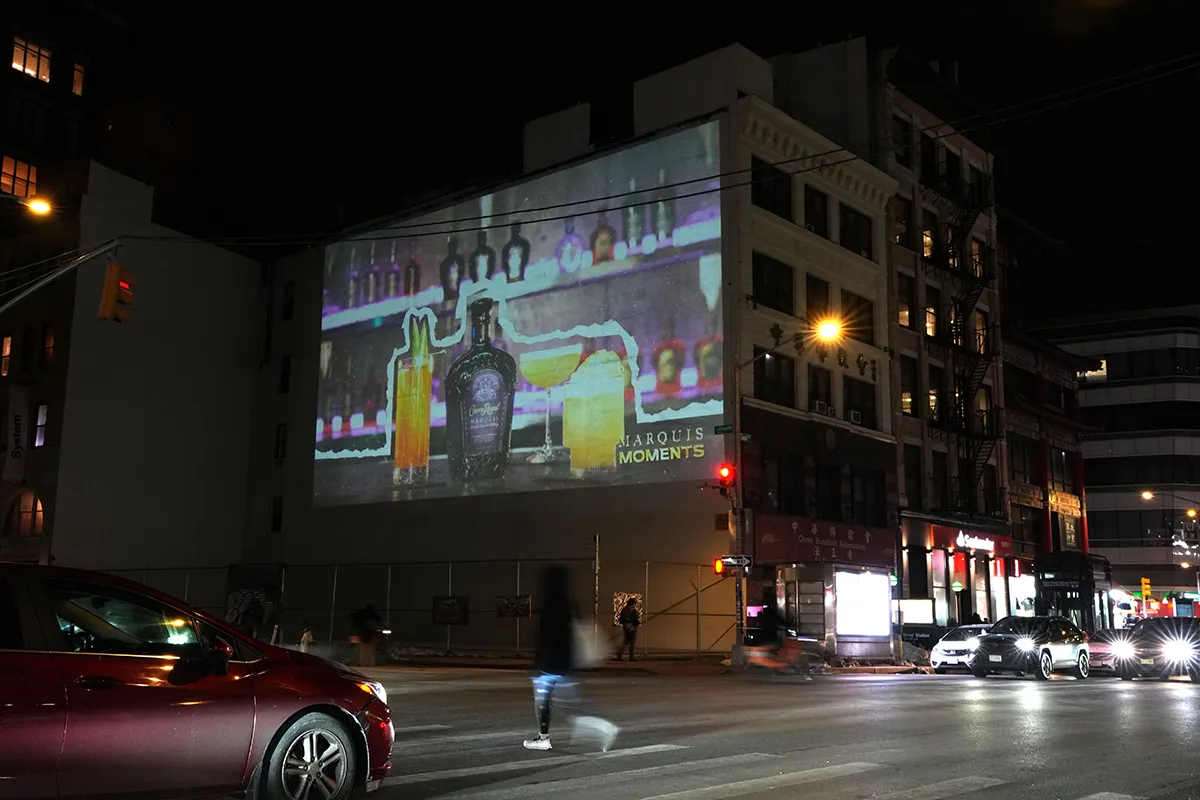
Even if the surface and geometry are correct, the projection still has to compete with its environment. A projection is only visible when it stands apart from surrounding light. Streetlights, storefronts, headlights, and nearby digital screens all reduce contrast. As that contrast drops, the image fades, even if the projector itself is powerful. This is where expectations often break down. Nighttime does not automatically create good conditions. In dense commercial areas, ambient light remains high, which can wash out the projection entirely.
There is also a secondary effect. Light reflecting off nearby surfaces, such as pavement, buildings, and glass, can push additional light back onto the projection surface. This further reduces clarity and makes the image harder to distinguish. So the evaluation becomes more precise. The question is not whether the location is dark. It is whether the environment allows the projection to maintain enough contrast to be clearly seen. Without that contrast, the building cannot support the projection, no matter how strong the surface itself may be.
Distance, Equipment Position, and Sightlines
If the surface and lighting conditions are viable, the next step is determining whether the projection can actually be executed and seen. Projection requires physical distance. The space between the projector and the building determines image size and sharpness. Without enough space, the projection cannot scale properly, limiting its impact. This is often where real-world constraints become clear. Narrow streets, limited access points, or a lack of secure placement can prevent proper setup, even if the building appears ideal.
Visibility from the audience perspective is just as critical. Any obstruction, such as trees, poles, parked vehicles, or scaffolding, interrupts the projection. These are not occasional issues. They are constant elements in urban environments and must be accounted for. Viewing angle also matters. People rarely stop and face a projection directly. They encounter it while moving, often from different directions and positions.
For pedestrians, the image needs to sit within natural sightlines as they move through space. For drivers, visibility is even more limited. The message must be understood almost instantly, often without direct focus. This reinforces the same point. A building is only effective if people can clearly see the projection for long enough to process it. Without that, the projection may exist, but it does not perform.
Audience Movement and Viewing Time
At this stage, the building may be technically viable, but performance still depends on how people move around it. High traffic is often treated as the primary indicator of a good location. In practice, it is incomplete. The number of people passing a building does not determine whether they will notice or understand the projection.
What matters is movement. Fast-moving environments reduce the time people have to engage with what they see. In those conditions, even a strong projection can be missed. Slower environments create better visibility. Intersections, crosswalks, transit stops, and gathering areas allow people more time to absorb the image.
Two locations with similar traffic volume can perform very differently based on how people move through them. A lower-volume area with longer viewing time can outperform a higher-volume corridor where people pass quickly without engaging. This is where the building must be evaluated in context. It is not enough for people to pass by. They must have the opportunity to see and process the projection for it to be effective.
Surrounding Conditions and Practical Constraints
The final step is understanding how the surrounding environment supports or limits the projection. A building does not exist in isolation. Nearby residential windows can cause light spill. Competing signage can draw attention away. Limited access can make installation unsafe or impractical. Local regulations may restrict projection or illumination.
These constraints often determine whether a campaign can move forward at all. This is where many initial assumptions change. A building may appear strong visually, but once the full environment is considered, it may no longer be viable.
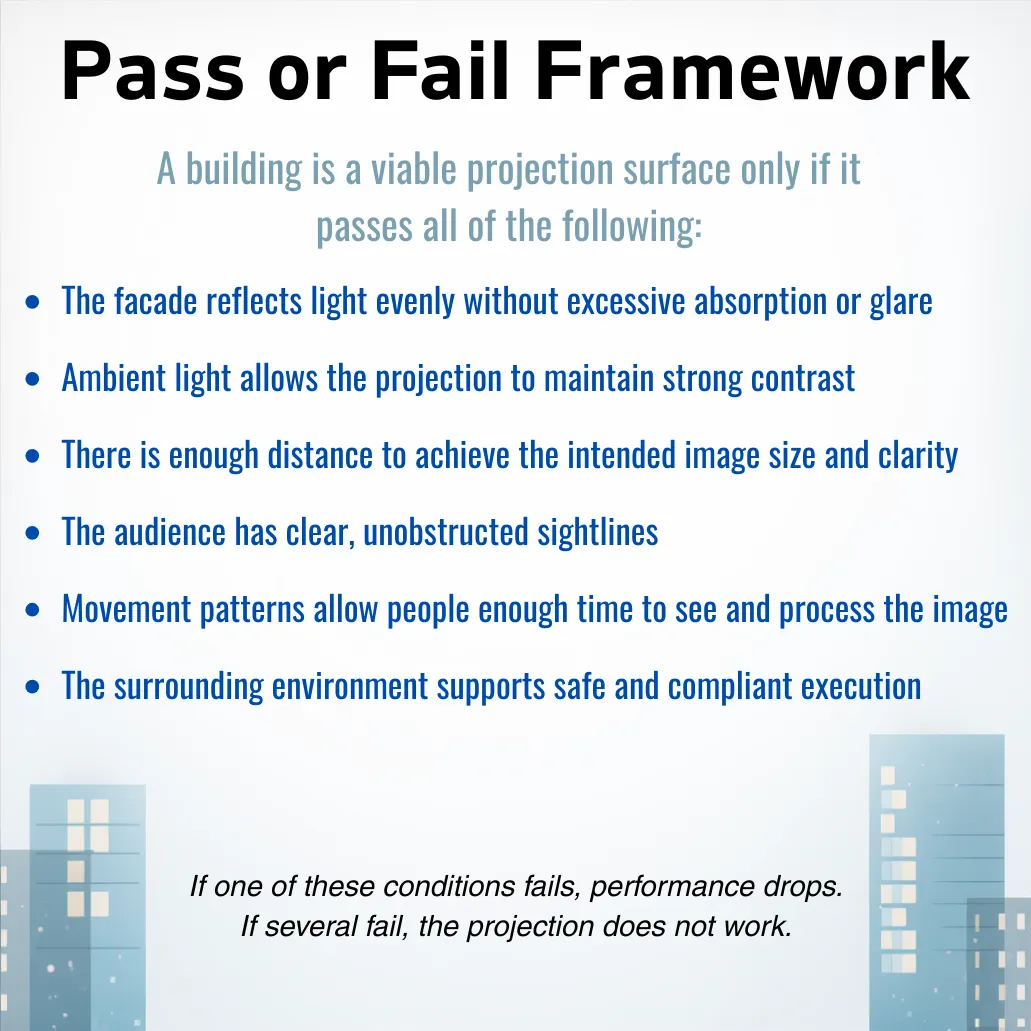
That brings the evaluation back to the central idea. A building is only suitable for projection when all conditions, surface, light, visibility, movement, and environment, align. If any of these fail, the projection loses effectiveness.
For more information on starting your project, give us a call today.
SEE OUR PROJECTIONS IN ACTION