4 Strategic Advantages of Projection Advertising
A building projection lasts only a limited time, but the campaign can retain value long after the equipment shuts down. Projection advertising gives brands control over scale, location, timing, and creative without requiring a permanent sign or printed installation. The format turns an existing surface into temporary media and makes the surrounding environment part of the idea. A building is no longer only a backdrop. It becomes part of how the message is seen and understood.
The strongest advantages come from how projection is planned and deployed. Brands can create large-scale visibility without permanently attaching material to a façade. They can consider urban surfaces outside standard billboard inventory. Digital creative also allows scheduled content changes and stronger visual documentation. Together, these qualities make projection advertising useful for launches, events, cultural moments, and campaigns tied to a specific place.
How Projection Advertising Differs From Other Out-of-Home Media
Traditional out-of-home advertising usually begins with established inventory. A billboard already has a fixed location, viewing angle, size, and campaign term. Wheatpasting builds street-level frequency through repeated poster placements. Murals create a longer presence because the image becomes part of the wall. Projection starts with the environment itself and asks how the building, audience, and timing can support the campaign.
The broader out-of-home market continues to move toward digital formats. U.S. out-of-home advertising revenue reached $9.1 billion in 2024, while digital out-of-home accounted for 34 percent of total spending and grew 7.5 percent from the previous year. Those figures cover the full digital out-of-home category, not projection advertising alone. They still reflect demand for media that supports digital creative and more flexible execution. Projection fits within that shift because the content can change without requiring printed material to be replaced.
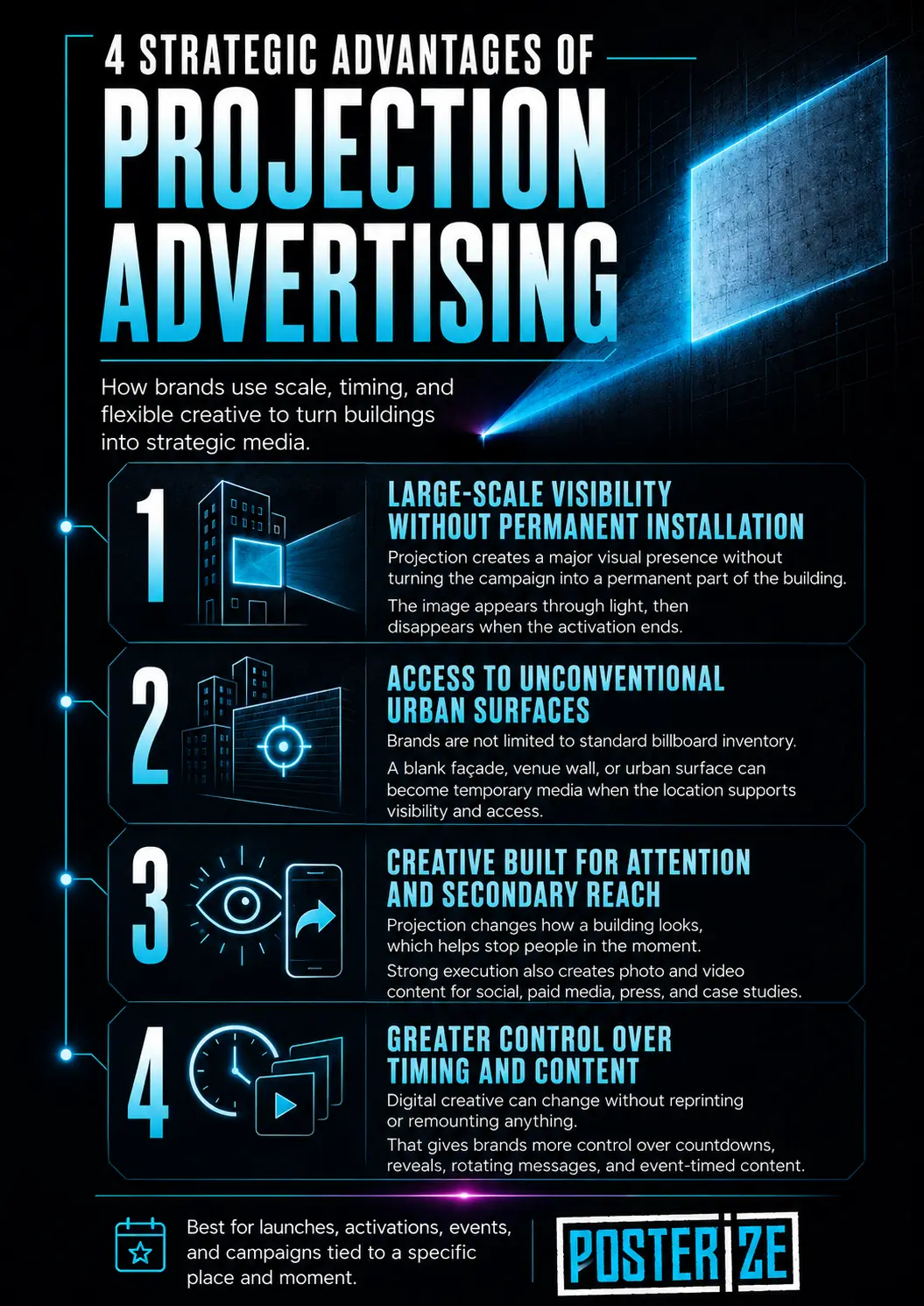
| Strategic advantage | What changes for the campaign | Best use cases | Main planning requirement |
| Temporary large-scale visibility | The image appears through light rather than permanent signage | Launches, activations, branded events | Site access, power, equipment placement |
| Unconventional urban placement | Buildings can be considered outside standard billboard inventory | Downtown areas, venues, entertainment districts | Clear sightlines, suitable surfaces, approvals |
| Secondary creative reach | The live activation produces useful photography and video | Social media, paid media, press, case studies | Strong concept and professional documentation |
| Timing and content control | Digital files can change without replacing physical media | Countdowns, reveals, rotating messages | Testing, scheduling, approved creative |
1. Large-Scale Visibility without Permanent Installation
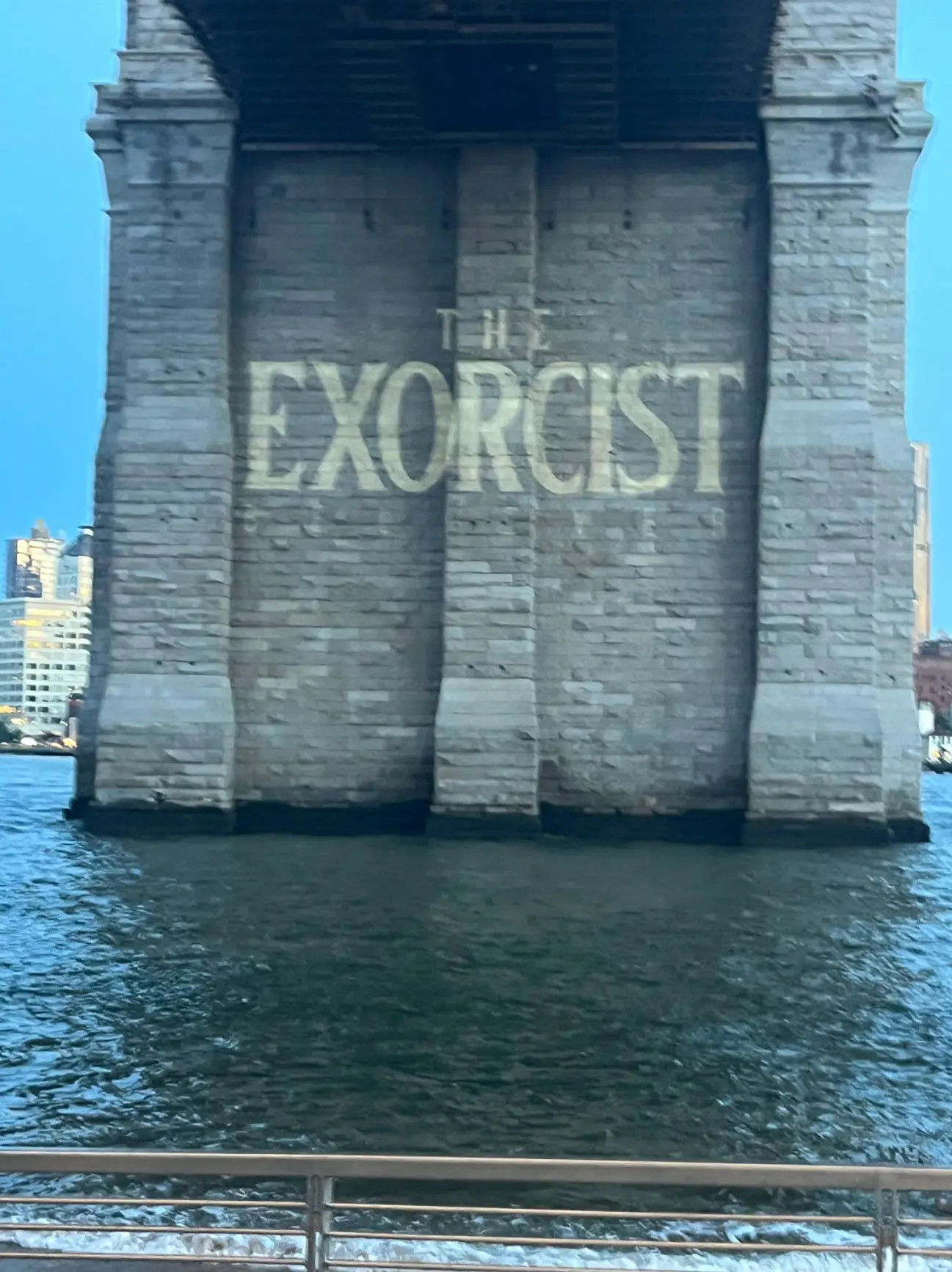
Projection advertising creates a large public presence without turning the campaign into a permanent part of the building. The image appears through light rather than paint, vinyl, wheatpaste, or a mounted billboard face. Once the projection ends, the advertising image disappears. No printed creative remains attached to the projected surface. This gives brands the scale of a major façade while keeping the media temporary. It also makes projection useful when the surface has architectural, cultural, or commercial importance.
The format still requires a physical operation to be performed behind the image. Equipment must be transported, positioned, powered, monitored, and removed. The site also needs access and approval. The advantage is not the absence of equipment or labor. It is the ability to create a large visual presence without adding a permanent advertising installation to the façade.
A projection campaign avoids several parts of a traditional installation:
- No printed billboard face needs mounting.
- No adhesive touches the projected area.
- No painted advertisement remains after the campaign.
- No permanent sign structure is added to the building.
- Creative removal happens when the projection ends.
This flexibility matters when the campaign needs to appear large without staying in place for weeks or months. A product launch might need one evening of concentrated visibility. A cultural event might need the building to change only during a scheduled program. A brand activation might need scale without committing the property to a long-term display. Projection gives each campaign a defined beginning and end.
2. Access to Unconventional Urban Surfaces
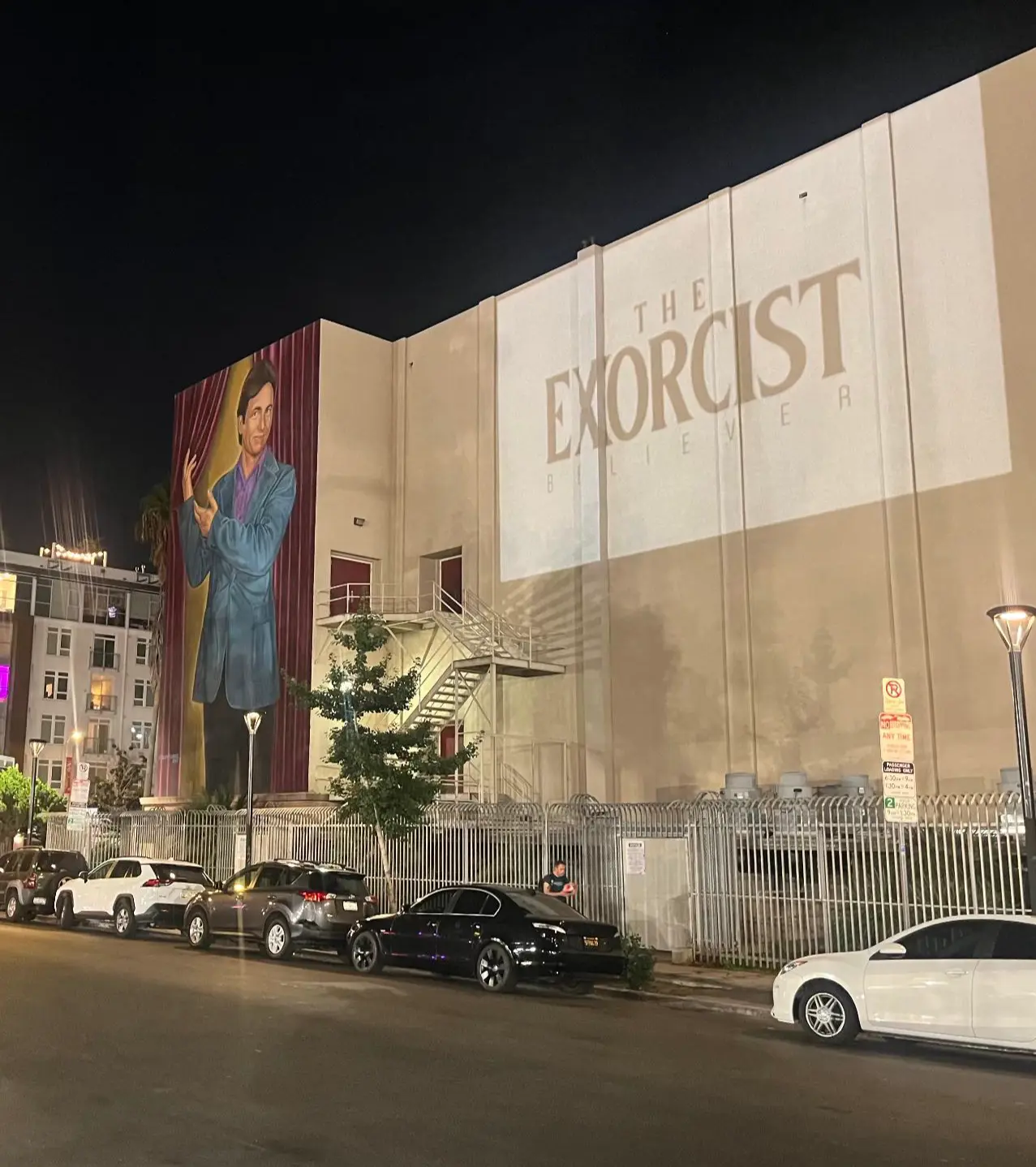
Traditional billboard campaigns depend on existing advertising inventory. The locations, dimensions, and viewing corridors are established before the brand begins planning. Premium placements are limited because several advertisers often compete for the same structures and campaign periods. Projection expands the search beyond those existing frames. A blank façade, warehouse wall, venue exterior, or architectural feature might become temporary media even when no billboard exists there. This gives planners another route to visibility in dense urban areas.
A strong projection location usually needs:
- A broad surface with limited obstruction
- A clear viewing corridor
- Enough darkness for strong image contrast
- A secure equipment position
- Property access and required approvals
A large wall is not automatically a useful wall. Trees, traffic, windows, streetlights, and neighboring buildings can weaken the image or block the audience’s view. The projector also needs enough distance and a stable operating position. Those technical limits make site selection part of the media strategy rather than a separate production task. The best location supports both the image and the campaign idea.
The setting can also add meaning. A launch near a conference venue can reach people already gathering for the event. A projection in an entertainment district can align with evening movement and nightlife. A façade connected to a neighborhood or cultural moment can give the creative more relevance. In those cases, the building does more than hold the message. It helps explain why the message is appearing there.
3. Creative Built for Attention and Secondary Reach
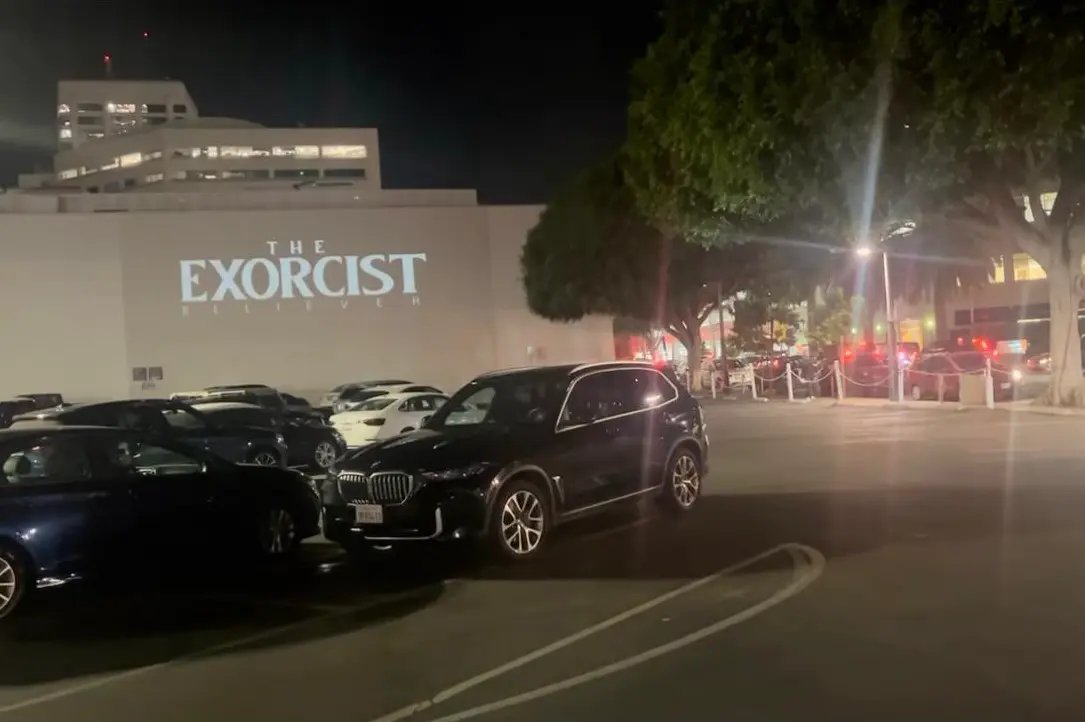
Projection advertising creates a visual interruption because people do not expect a familiar building to move, change, or carry a large digital image. Scale creates the first point of contrast. Motion gives the audience a reason to keep watching. The location makes the creative feel connected to a real public moment rather than another image on a screen. These conditions give the campaign stronger potential to attract photography, video, conversation, and mobile activity. The result still depends on whether the idea gives people a reason to care.
A 2024 Harris Poll commissioned by the Out of Home Advertising Association of America surveyed 1,023 U.S. adults between the ages of 18 and 64. Seventy-three percent viewed digital out-of-home advertising favorably. 80% reported a greater likelihood of taking action after seeing digital out-of-home creative they found entertaining or visually appealing. 71% reported being likely to share digital out-of-home advertisements featuring a favorite product or brand. Among mobile users, 74 percent reported taking action on a phone after recent digital out-of-home exposure. These figures broadly cover digital out-of-home, but they support the value of visually distinctive public creative connected to mobile behavior.
Projection supports secondary reach when the campaign is designed for both the live audience and the camera. The image needs enough contrast to hold up in photographs. Motion should move at a pace that works in short video clips. Branding should remain clear without overwhelming the concept. Professional documentation then provides the brand with reliable assets, even when organic sharing varies.
Strong projection creative usually includes:
- An idea people understand within seconds
- Motion that transforms or responds to the building
- A clear relationship between the location and the message
- Branding that stays readable in photos and video
- Planned photography and video capture
Projection does not guarantee social reach or press attention. No format does. Its advantage lies in creating visual conditions that support stronger digital out-of-home attention and sharing potential. When the concept, site, execution, and documentation align, one temporary activation can produce content for social media, paid promotion, email, press, and future case studies.
4. Greater Control over Timing and Content
Printed out-of-home media connects creative changes to physical production. A new billboard face must be printed and installed. A poster campaign needs new materials to be placed along the route. A mural requires another painting process. Projection works from digital files, so approved creative can change without replacing the advertising surface. This gives the campaign more control over timing, sequence, and message variation. One site can support several planned moments during the same activation.
A campaign might begin with a countdown before moving into a product reveal. Content can change when an event starts or when an announcement becomes public. Different messages can appear at different times during the evening. Sponsors or product variations can rotate through a planned sequence. The same campaign system can also support location-specific files across different cities.
Useful timing formats include:
- Countdowns leading into a reveal
- Messages tied to an event schedule
- Multiple creative versions during one evening
- Location-specific content
- Time-sensitive announcements
Context also affects how useful people find digital out-of-home messages. The 2024 Harris Poll found 81 percent of respondents considered weather-related offers useful. Another 80 percent considered time-specific offers useful for categories such as food, beverages, clothing, shoes, and accessories. Projection campaigns do not need programmatic buying systems to apply the same principle. A message becomes more relevant when its timing reflects what the audience is doing at that moment.
WARC has also identified scheduled creative, targeted activations, and trigger-based buying as major strengths within programmatic digital out-of-home. Projection uses a different technical process, but digital files provide a related strategic benefit. The brand controls which approved message appears and when. That control is especially useful for launches and event-driven campaigns where timing carries meaning.
Is Projection Advertising Right for the Campaign?
Projection advertising does not replace every other out-of-home format. Billboards support repeated exposure over longer periods. Wheatpasting creates street-level frequency across several locations. Murals establish a lasting relationship between a brand and one wall. Projection serves a different role when temporary scale, scheduled visibility, and location-specific creative matter most.
Reach out to Posterize Media today to start your campaign.