Does Guerrilla Marketing Work? What a Guerrilla Marketing Agency Should Prove
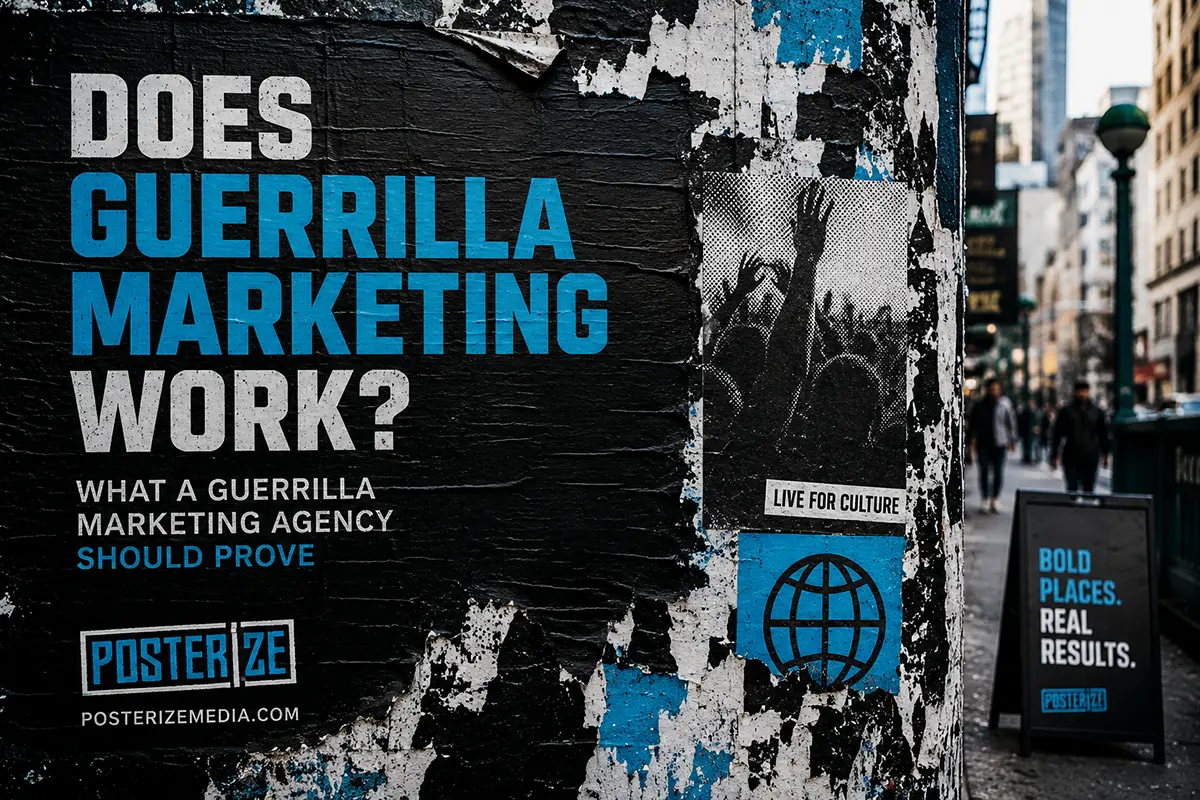
Guerrilla marketing is often judged too much by taste. One person sees a street campaign, projection, pop-up, or wall of posters and calls it a stunt. Another sees the same campaign and calls it smart because it got people talking. Neither reaction gives a brand or agency enough to make a serious decision.
The better question is not whether guerrilla marketing looks bold. The better question is whether the campaign creates measurable attention, action, earned media, engagement, sales lift, or documented public visibility. The strongest campaigns show that guerrilla marketing works when the idea is clear, the placement is intentional, and the audience has a reason to respond.
At Posterize Media, we look at guerrilla marketing through execution and evidence. A serious guerrilla marketing agency should help a campaign show up in the right place, reach the right audience, and leave behind proof the client can review. That means placement strategy, installation documentation, location-level reporting, campaign maps, photo proof, and clear proof of performance.
The Numbers Are Too Strong to Ignore
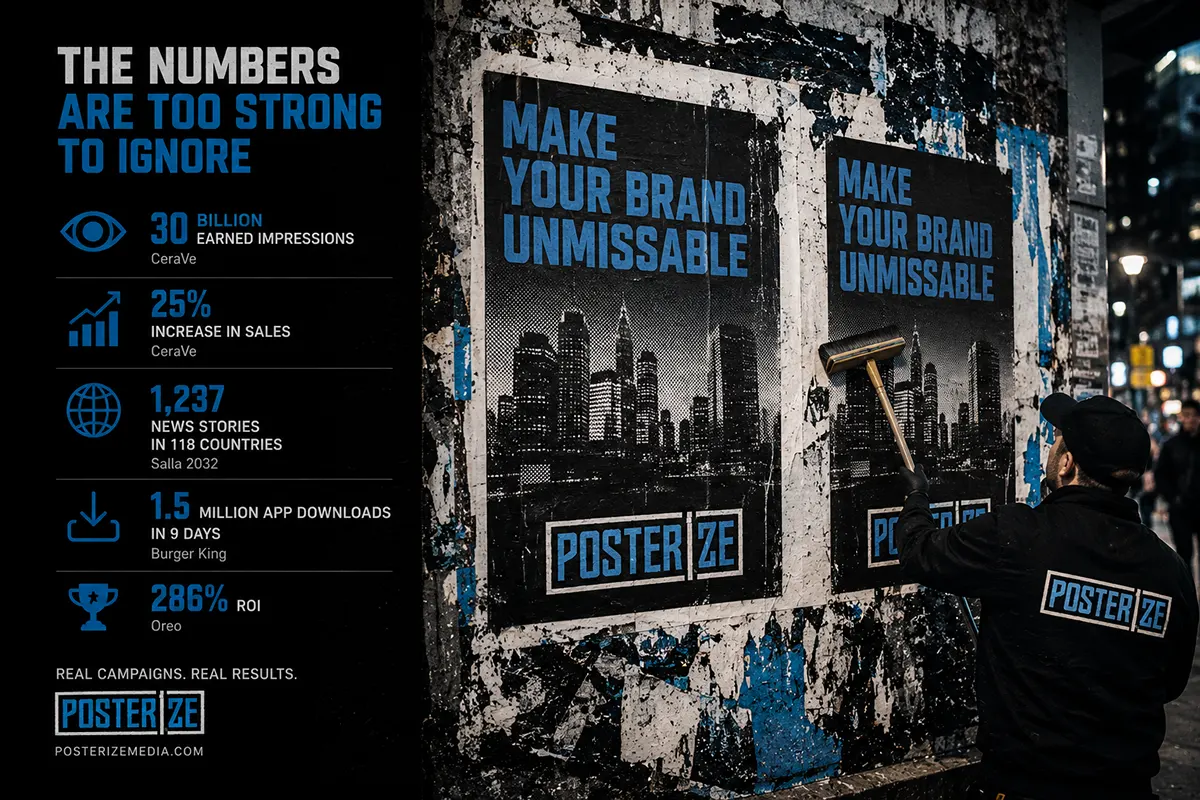
The strongest guerrilla campaigns do not rely on a single type of outcome. They first capture attention, then turn that attention into measurable action, earned media, engagement, or sales. That distinction matters because a campaign with millions of impressions but no clear outcome is still incomplete. The best examples show both visibility and movement.
Start with attention. CeraVe's Michael CeraVe campaign generated more than 9 billion impressions before the Super Bowl and 30 billion earned impressions across the full campaign. The campaign also reported a 25% increase in CeraVe sales, making the result more than just a visibility story. The campaign worked because the setup gave people something to question, repeat, and follow before the official media moment arrived.
Salla 2032 shows the same attention pattern through location and earned media. The campaign positioned Salla, one of Finland's coldest places, as a candidate city for the 2032 Summer Olympics to raise awareness of global warming. The campaign generated 1,237 news stories in 118 countries, 7.586 billion media impressions, $157 million in earned media value, an 879% increase in social conversation about global warming, and 1.2 million Twitter mentions over three weeks.
Then look at action. Burger King's Whopper Detour did not stop at public attention. The campaign used geofencing around 14,000 McDonald's locations to unlock a one-cent Whopper through the Burger King app, then directed users to the nearest Burger King. It generated more than 1.5 million app downloads in 9 days, 3.3 billion impressions, and performance Burger King reported as 40 times stronger than any previous app promotion.
Engagement tells the same story from another angle. Oreo's Doomsday Vault campaign turned one fan tweet about an asteroid into a physical vault concept inspired by the Global Seed Vault. The campaign earned 415+ media placements, generated more than 100 million impressions, delivered a 286% ROI, attracted participation from 20+ major brands, and produced 75% more engagement than a standard Oreo post.
Key numbers:
- 30 billion earned impressions for CeraVe's Michael CeraVe campaign.
- 25% reported increase in CeraVe sales.
- 1,237 news stories in 118 countries for Salla 2032.
- $157 million in earned media value for Salla 2032.
- 5 million app downloads in 9 days for Burger King's Whopper Detour.
- 3 billion impressions for Burger King's Whopper Detour.
- 40x stronger performance than Burger King's previous app promotions.
- 415-plus earned media placements for Oreo's Doomsday Vault.
- 286% ROI for Oreo's Doomsday Vault.
- 75% more engagement than a standard Oreo post for Oreo's Doomsday Vault.
Taken together, these numbers do not prove that every guerrilla campaign works. They prove that guerrilla marketing has measurable upside when the campaign has a clear idea, a strong placement strategy, and a defined path from public attention to client value. That is the difference between a stunt and a serious campaign.
What the Numbers Tell Us
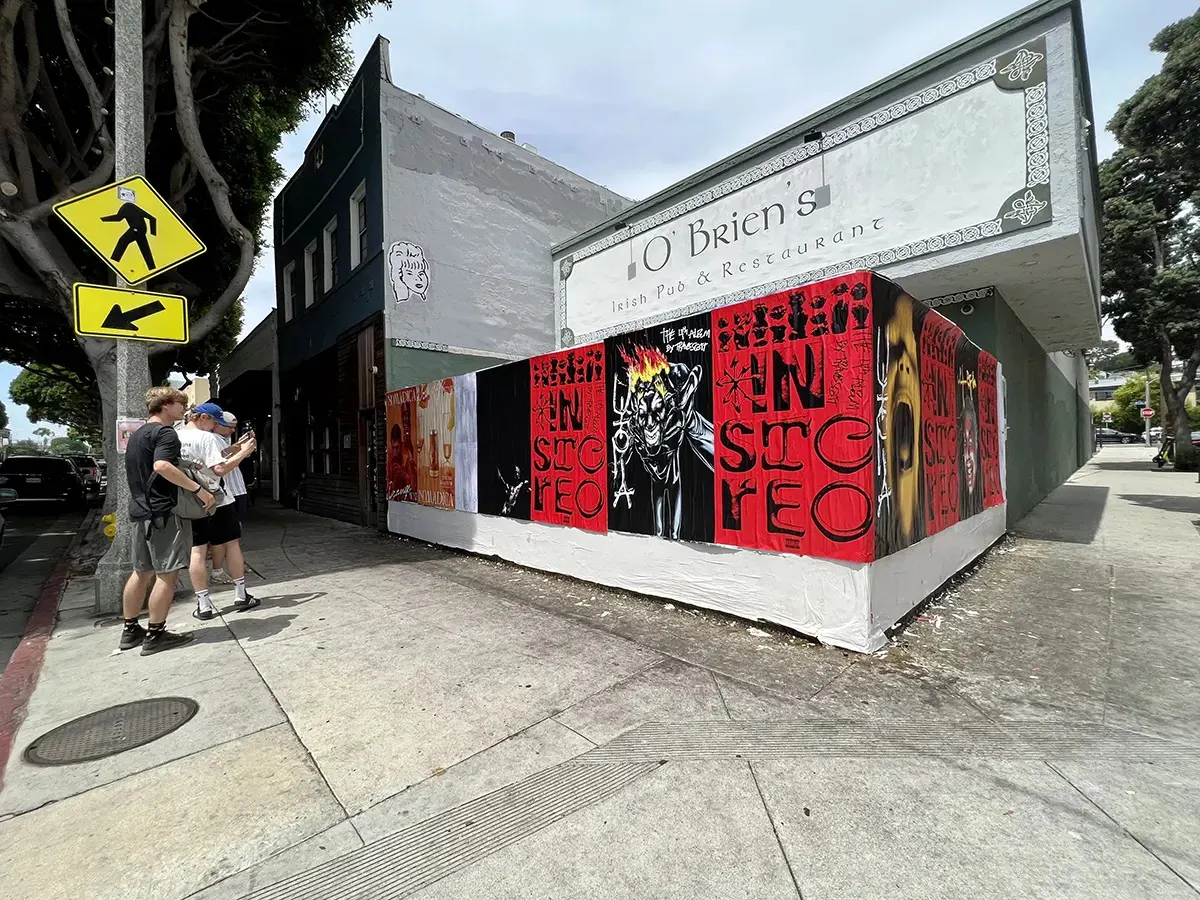
The pattern is not that strange ideas win. The pattern is that measurable guerrilla campaigns usually do four things well. They make the idea easy to understand. They put the message in a place where the audience already exists. They give people a reason to photograph, share, scan, search, visit, download, or talk. They create a reporting trail after the campaign goes live.
That last point matters for brands and agencies. A campaign that looks good in the street still needs proof behind it. Clients need to know where placements went live, how many placements were completed, what markets were covered, and what evidence supports the campaign recap.
This is where Posterize's process matters. Street media is physical, but reporting should not feel vague. Our campaigns focus on visible execution and documented proof, including campaign maps, installation updates, placement counts, photos, and Live Link access when applicable.
When Guerrilla Marketing Works
Guerrilla marketing works best when the campaign has a clear job. A campaign for a launch, film, fashion drop, music release, sports activation, event, or agency-led brand moment needs more than visibility. It needs the right visibility in the right environment, aimed at the right people, at the right time.
This is where placement matters. A wheatpasting campaign in a high-foot-traffic corridor works differently from a projection near an event venue. A sticker campaign near nightlife traffic works differently from a street team activation near a convention center. The medium has to match how the audience moves through the city.
The strongest campaigns usually share the same working conditions. The message is simple enough to understand in seconds. The location supports the idea. The audience is already present. The creative gives people a reason to react. The client has a way to review what went live and where.
When Guerrilla Marketing Does Not Work
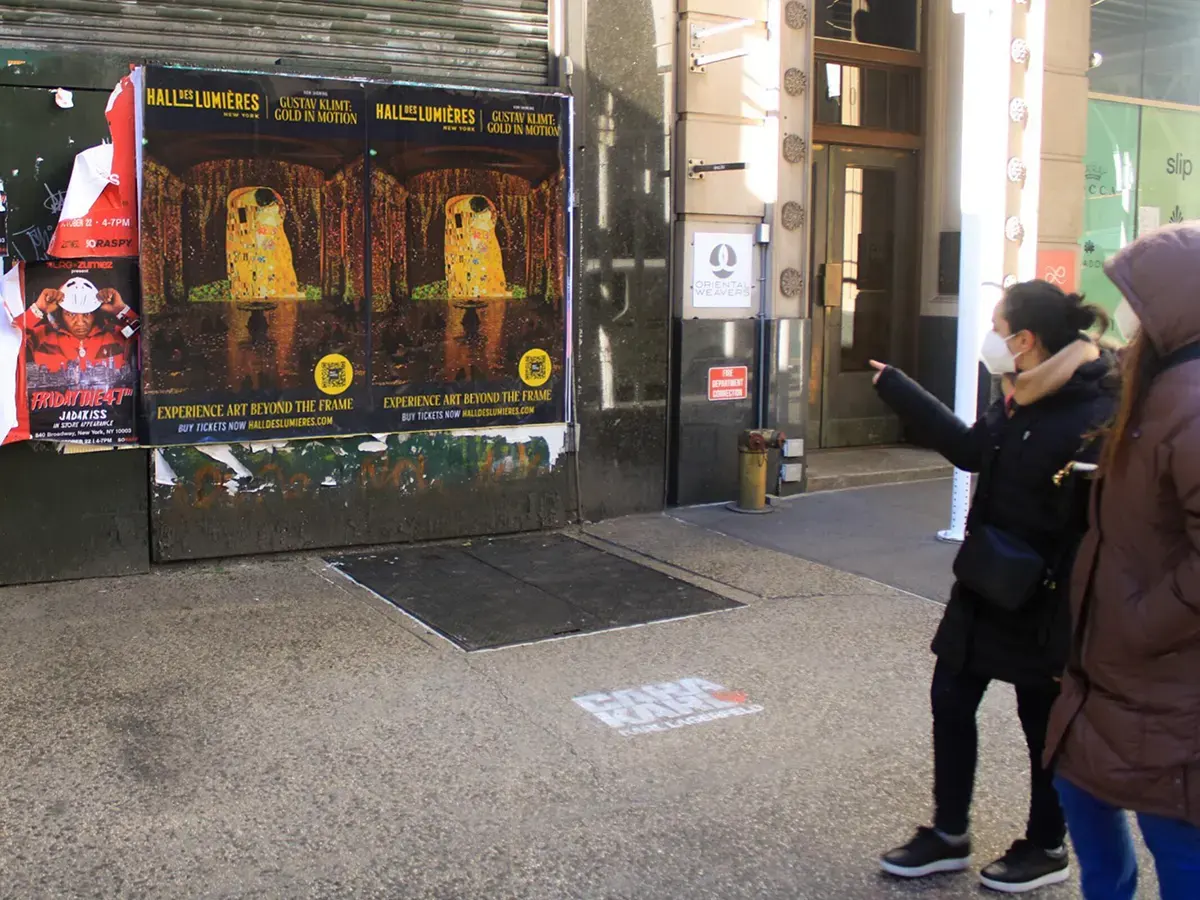
Guerrilla marketing does not work well when the campaign chases attention without a clear business reason. A strange idea with no brand connection gives people something to notice, but not something to remember. A public installation with no documentation creates a reporting problem for the client. A high-visibility campaign in the wrong area puts the message in front of people who were never likely to care.
It also fails when the campaign has no next step. If the goal is awareness, the campaign still needs proof of placement and market coverage. If the goal is traffic, the campaign needs a QR code, a URL, an offer, an event tie-in, or a search behavior strategy. If the goal is cultural conversation, the campaign needs an idea people understand fast enough to repeat.
There are no guarantees. Weather, timing, audience behavior, news cycles, city conditions, creative strength, and brand relevance all affect performance. That is why a serious guerrilla campaign should not rely on vibes. It should rely on planning, execution, and proof.
What Brands Should Expect from a Guerrilla Marketing Agency
The data makes the case, but only if brands read it correctly. Guerrilla marketing is not a magic trick. It is a high-attention channel that performs best when the concept, location strategy, and measurement plan are built together from the start.
At Posterize Media, we help brands and agencies bring that discipline to street-level campaigns. Our work is built on real-world visibility and client confidence. That means campaign maps, installation updates, placement counts, photo documentation, and proof of performance through Live Link, when applicable.
The numbers show that guerrilla marketing works when it gives people something worth noticing and gives the client something worth measuring. That is the standard. Not hype. Not guesswork. Proof.
What the Data Proves
- Guerrilla marketing works best when attention has a next step.
- Earned media matters more when the idea is simple enough for others to repeat.
- Location and timing make the campaign easier to understand and spread.
- Impressions alone are not enough. The campaign needs engagement, action, sales, or proof of performance.
- The strongest campaigns are not random stunts. They are planned public campaigns with measurable outcomes.
- Brands and agencies should judge guerrilla marketing by execution, documentation, and results, not by whether the idea feels loud or unconventional.